

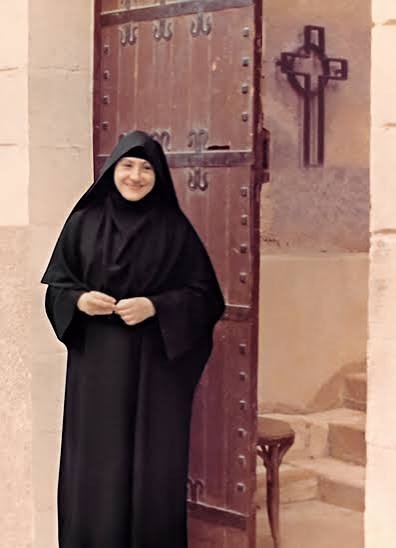
Commemorated at St. Peter & St. Andrew Church on Saturday, October 31, 2026 — twenty years to the day since her departure
My beloved, this Saturday we gather to remember one of the brightest lights God has given His Church in our own generation: Tamav Irene, abbess of the Convent of St. Philopater Mercurius (Abu Seifein) in Old Cairo. On October 31, 2006, after forty-four years as mother of that convent and some twenty-five years of illness carried with thanksgiving, she departed to the heavenly Jerusalem.
Many of our parents and grandparents knew her, visited her, or were anointed by her. Many of our young people have only heard her name. I want every family at SPSA to know her story, because hers is not a story from the fourth century. She lived in our time, in a busy modern city, and still lived a life the desert fathers would have recognized. What follows is her life from birth to departure, drawn mainly from the convent's own account, The Life of Tamav Irene.
"She Is Ours": Birth and Childhood in Gerga
Tamav Irene was born Fawzia Yassa on February 9, 1936, in Gerga, a small town in Upper Egypt. Her parents, Yassa and Genevieve, were people of deep prayer and quiet, generous charity.
Her birth was difficult. While her father ran to the church of St. George to ask for the saint's prayers, her mother wept and called on the Virgin Mary. The family tells that the room filled with light, and the Mother of God appeared with St. George. The saint touched Genevieve, and the child was born at once. Holding the newborn, the Virgin made the sign of the cross and told the mother, in effect, that this child was not hers but heaven's, and that she must raise her well.
That word, she is ours, followed Fawzia all her life. She was baptized at the Monastery of St. Shenouda the Archimandrite in Sohag, and the bishop saw the saint himself blessing the child. When she was about a year old, a scorpion stung her and she went cold and still. Her mother cried out to St. Shenouda, and the family tells that he came, breathed on her face, signed her forehead with the cross, and repeated the same words: do not be afraid, she is ours. The family kept that day as her second birthday and visited his monastery every year after.
Fawzia learned to pray at her mother's side. As a little girl she would slip into her mother's room at night to watch her pray the Agpeya hours and make her prostrations, and her mother taught her to do the same. She later said that praying with a broken and contrite heart was carved into her from childhood. The house was full of the saints: an icon of the Archangel Michael with its lamp always lit, bread baked on his feast every month, and great love for St. George and the Virgin, through whose prayers her mother was healed of a long illness.
A Heart Set on God
Fawzia grew up watching love put into action. Her mother cooked extra food for the poor and sent her daughters to deliver it quietly, at hours when few people were in the streets. Her grandfather, Matta El-Faizy, an archdeacon and timber merchant, would take her on his carriage to leave envelopes of money and baskets of food at needy doors, knocking and leaving before anyone could see who it was. Her father gave his employees extra money from his own drawer, by the handful, without counting. From them she learned that charity is done in secret, before God alone.
As a teenager she fasted strictly, received Communion and confessed regularly, and spent whole days with her friends at the Church of the Virgin in Gerga, praying and cleaning it when the old priest could no longer keep it up. When a woman began drawing Orthodox youth away from the Church's faith, young Fawzia did not stay quiet. She invited the girls to her home and taught them about repentance, confession, and constant vigilance, and the gathering dwindled. She defended the honor of the martyrs and the monastic life with courage beyond her years.
From childhood she longed to be a nun. She built a little chapel in her room with icons of Christ, the Virgin, and St. George, kept a lamp burning before them, and brought fresh flowers daily. She and her young aunt, whom the family called Dida, played at being nuns on the roof, fasting and measuring their height with a rope to see how fast they were growing up. When Dida was pushed into marriage against her will, she prayed tearfully before the Virgin's icon and, the family tells, died suddenly before the wedding. Fawzia grieved deeply until, in a vision, Dida appeared among radiant virgins and told her she would one day become a nun and a mother to many spiritual daughters.
Fawzia then prayed for a convent. In repeated visions, St. Philopater Mercurius, Abu Seifein, the "one with the two swords," appeared to her and told her he wanted her in his convent in Cairo. She had never even read his life. Her parish priest, Fr. Boutros, opened the Synaxarium and read it to her for the first time, and counseled her to be patient and guard against pride.
Leaving Everything: The Convent of Abu Seifein
God arranged the way. A nun of the Abu Seifein convent, Omena Maria, came to Gerga to visit her sister, and Fawzia befriended her and opened her heart. Her father, who loved her tenderly, could not bear to let her go and offered to build her a cell on the roof instead. Her parents fasted and prayed for fifteen days before the Nativity Fast to learn God's will.
During those days her mother saw the Virgin again, enthroned among angels. The Mother of God reminded her of the words spoken at Fawzia's birth and told her to let her daughter go. Fawzia's confessor wisely persuaded her father, too, and Fawzia herself had a vision of St. John Chrysostom assuring her that the matter was settled. When she went to her parents, they told her, smiling, that they had agreed.
On the night before she left, an uncle arrived furious, determined to sit by the door and stop her. The family tells that he fell into a deep sleep, and she left in peace. On April 16, 1953, Fawzia arrived in Cairo and asked to join the poor, struggling convent of St. Philopater Mercurius in Old Cairo, rather than a better-established one, because that was where the martyr had called her.
Her first days were hard. It was Holy Week, she had no cell, and for three days she asked for nothing. An elderly nun took pity on her and fed her. Months later, on Monday, October 26, 1953 (Babah 16, 1670 A.M.), she was consecrated a nun by Fr. Makar El-Makary in the church of Abu Seifein next to the convent and given the name Irene. Lying under the funeral pall during the rite, she prayed that God would make her die to all the vanities of the world and make her His alone.
The Young Nun: Warfare, Obedience, and Humility
The enemy of all good did not leave this young bride of Christ in peace. In her first cell, on her very first night, she later told of a terrifying dark figure threatening her with a knife. She cried out, "O power of God, save me," and collapsed. Her abbess, Tamav Kyria Wassef, anointed her and taught her a lesson she repeated all her life: the devil is like straw; make the sign of the cross and he vanishes. When frightening visions of snakes came during her prostrations, her confessor told her to bow straight onto them, and in obedience she did, and they disappeared. Once, when a kerosene tank caught fire in the kitchen, she called on Abu Seifein, and she said she saw him sign the flames with the cross and they went out.
The subtler war was in her thoughts. The enemy whispered that all her work left no time for prayer and that she should go home and live as a nun there. Abu Seifein appeared and told her that a nun who leaves her convent is like a fish taken out of water. She learned to pray the psalms while she worked and to carry the Agpeya everywhere, and she said that from then on she felt she was living in paradise despite the hard labor.
She was the youngest, and much of the work fell on her shoulders, often from four in the morning until ten or eleven at night. She asked God to bless her few hours of sleep so she could still rise for the midnight praise. She told the nuns that her guardian angel would wake her each night, calling her name three times. When she was kept from the Liturgy for three months by her duties and accepted it without complaint, she told of being carried that night to a hidden church in the desert to pray with the Sowah, the hidden anchorites, and returning with a piece of blessed bread, which her abbess divided among the sisters.
She learned obedience as the gem of the monastic life. An older nun once called her again and again to sweep the corridor, then told her to stop each time; she answered "Yes, mother" every time. When she wanted to stop at St. Mercurius' church instead of where her abbess had sent her, she found she could not walk toward it until she turned back in obedience. She concluded that God listens to those who obey.
One evening, after quietly criticizing some sisters in her heart, she told of being shown a dark, foul place where nuns wept because they had judged their superiors and sisters. She was let out by a narrow, painful path back to her convent, and woke with her back truly bruised. From that day she resolved never to judge anyone. She even plugged her ears with cotton so she would not hear convent gossip, and if anyone started to tell her about someone else, she would answer, "I have not heard, and I do not want to know."
Abbess at Twenty-Six
Heaven had been preparing her for leadership long before she knew it. When a severe headache troubled her as a novice, she was taken to the hermit-priest Fr. Mina El-Baramousy, the future Pope Kyrillos VI. He prayed over her and told her companion that this girl would one day be abbess of the convent and that in her days many altars would be built and many would join. An elderly saintly nun, Omena Euphrosena, said the same when she first saw her. Her own abbess, Tamav Kyria, received a vision of St. Anthony, St. Shenouda, and St. Pachomius handing Irene a lamp, and told her plainly that she would carry the responsibility after her.
Irene wept and refused every time. In 1956 her mother departed, and Irene went home for a season of mourning. She told of being met on a dark railway platform by a radiant officer who helped the nuns, found them seats on a crowded train, and rode with them to Gerga before vanishing. When pressed for his name, he said he lived in the convent of St. Mercurius: it was Philopater Mercurius himself.
On September 25, 1962, Tamav Kyria departed. The next day a letter came from Pope Kyrillos VI naming Irene, the youngest nun among more than fifty, as abbess. She went to the Pope in tears and recommended older, wiser sisters instead. He listened kindly and sent her home in peace. Then, before dawn on Monday, October 15, 1962, after the midnight praise, she was told the Pope was sending a bishop to celebrate the Liturgy. The sisters gently brought her to church, and only then did she realize what was happening. Weeping like a lamb led to the slaughter, she was consecrated abbess. The Gospel was the Good Shepherd from John 10. The Pope sent his own schema for her to wear.
When she later protested to him that she could not keep the schema's rule of psalms and prostrations alongside all her duties, he answered that she should pray the psalms as she moved about her work, and that he had prayed fervently and found this to be God's will.
Renewing the Convent
When Tamav Irene became abbess, the convent was neither fully communal nor fully solitary. Each nun cooked for herself in her cell, there was no common table, and communal prayer was held only once a day. She fasted and prayed for three days for guidance. She told of being brought before St. Pachomius, the father of communal monasticism, who told her that God wanted her to follow the communal life as the safe middle path that has saved many: one table, one habit, all treated equally. Afterward she found a manuscript on the Pachomian rule in the convent's own library that she had never read.
She introduced the reforms gently. The nuns began eating together while she read the lives of the saints and the Paradise of the Monks aloud. Prayer in church became three times a day, from the midnight praise through the hours of the morning and again in the evening. Some older sisters resisted at first, but years later one of them confessed before her departure that Tamav had won their hearts by love and patience. In time, this communal life was adopted in other Coptic convents as well.
She loved the hymns of the Church as its most treasured possession. As a girl in Gerga she had spent her pocket money learning them from the church cantor, and as abbess she kept studying with the great cantors of her day. She told her daughters of the joy in heaven during the midnight praise. In one vision she shared, the Virgin gave a lit lantern to each nun who came gladly, an unlit one to those who came grudgingly, and nothing at all to those who stayed asleep in their cells.
The convent had no church of its own, and the elderly nuns struggled to reach the Liturgy next door. Two years into her service she began building churches within the walls, fulfilling the prophecy of Pope Kyrillos that the convent would have more than one altar. She founded a library, renovated and expanded the buildings, and the number of nuns grew greatly. In the 1990s a second Abu Seifein convent was established on Egypt's North Coast. Under her guidance the convent also published works recovering the forgotten role of women in the history of monasticism.
A Mother to Many, and a Martyr Without Blood
Tamav Irene led as a mother, not a ruler. She never forced a nun beyond her strength, gave no special privileges except to the sick and weak, and spoke to each sister with the counsel she needed. She taught that the Kingdom of God is gained not by silver or gold but by humility, purity of heart, and love for all without distinction. In an interview she once said she preferred words of love and encouragement to pointing out her sisters' faults. Yet she was no pushover: once she knew what was right, she did not budge.
Her love reached far beyond the convent walls. Coptic families from Egypt and around the world came to ask her prayers. Pope Kyrillos VI had given her the unusual blessing of anointing people with holy oil, and crowds came to receive it. She would tell visitors, with simplicity and joy, of the saints' care and the wonders God had done. Many Copts considered her a living saint, and countless healings and answered prayers are attributed to her intercession, both in her lifetime and after.
For her last twenty-five years or so, she suffered repeated, grave illnesses, including cancer, and more than once came close to death. She received treatment abroad, including in Switzerland, yet she never complained. From her youth she had longed for the crown of martyrdom. She shared that during one of those trips, in 2001, St. Mercurius appeared to her and told her that God had allowed this pain as a cross, and that suffering endured with thanksgiving is like the suffering of a martyr. When the Virgin once asked if she wanted to be a martyr, she answered that she was weak and helpless and could only endure with the Virgin's help. Her abbess had taught her long before that bearing hardship and contempt for Christ's sake is exactly like martyrdom. In her last years, she lived that teaching in her own body.
Her Departure: October 31, 2006
On Tuesday, October 31, 2006, Tamav Irene departed to the Lord at al-Hayat Hospital in Heliopolis, Cairo, at the age of seventy. She had been a nun for fifty-three years and abbess for forty-four.
Her daughters carried her body home to the convent, performed the last rites, and laid her in the church of the Archangel Michael. They then brought her down to the church of Abu Seifein, where they sang the midnight praise and prayed the Liturgy at dawn, the very praise she had loved and taught. In the morning the convent opened its doors, and thousands queued to say farewell to their mother.
On Thursday her body was moved to the larger church of the Virgin for another praise and Liturgy, followed by the funeral rite for nuns. A bishop delegated by Pope Shenouda III, who was then recovering from surgery abroad, prayed with bishops, priests, abbesses of other convents, officials, and a great congregation. The clergy carried her coffin across the garden to rest near the baptismal font of the convent, while the nuns followed in procession, each holding a lit candle. Her shrine there remains a place of pilgrimage to this day.
Her life continues to bear fruit. Her life story has been translated into English, Amharic, and other languages, and people across the world testify that reading it led them back to prayer, fasting, and repentance.
What Tamav Irene Teaches Us
We do not remember her only to admire her. We remember her so that we may imitate her faith (Hebrews 13:7). Let me leave you with three lessons from her life:
1. Prayer is the whole life, not part of it. She learned it at her mother's side and kept it through eighteen-hour workdays by praying the psalms as she worked. If she could pray amid that labor, we can pray in our cars, our kitchens, and our offices.
2. Humility guards the heart. She refused honor, obeyed without arguing, and would not listen to gossip about anyone. In a world that loves to judge, her plugged ears are a holy example: "I have not heard, and I do not want to know."
3. Suffering offered to God becomes a crown. For twenty-five years she carried illness with thanksgiving and called it martyrdom. Whatever cross you carry this week, offer it to Christ, and it will not be wasted.
Please join us at St. Peter & St. Andrew Church on Saturday, October 31, 2026, as we commemorate the twentieth anniversary of her departure:
♰ 6:00–7:00 PM — Vespers and veneration of the relics
♰ Following Vespers — Tasbeha (Midnight Praise), the praise she loved and taught her daughters
Bring your families, and teach your children her name.
May the Lord bless us and transform us — that our homes may stand on the Rock, our hands may serve in the harvest, and our hearts may long for Heaven. Through the intercession of our Lady, the Theotokos Saint Mary, the prayers of St. Philopater Mercurius and of our mother Tamav Irene, and the prayers of Saint Peter and Saint Andrew. Glory be to God forever. Amen.
Hegumen Fr. Andrew Awad
St. Peter & St. Andrew Coptic Orthodox Church, Stamford, CT