

The Coptic Church · Art
Coptic Iconography
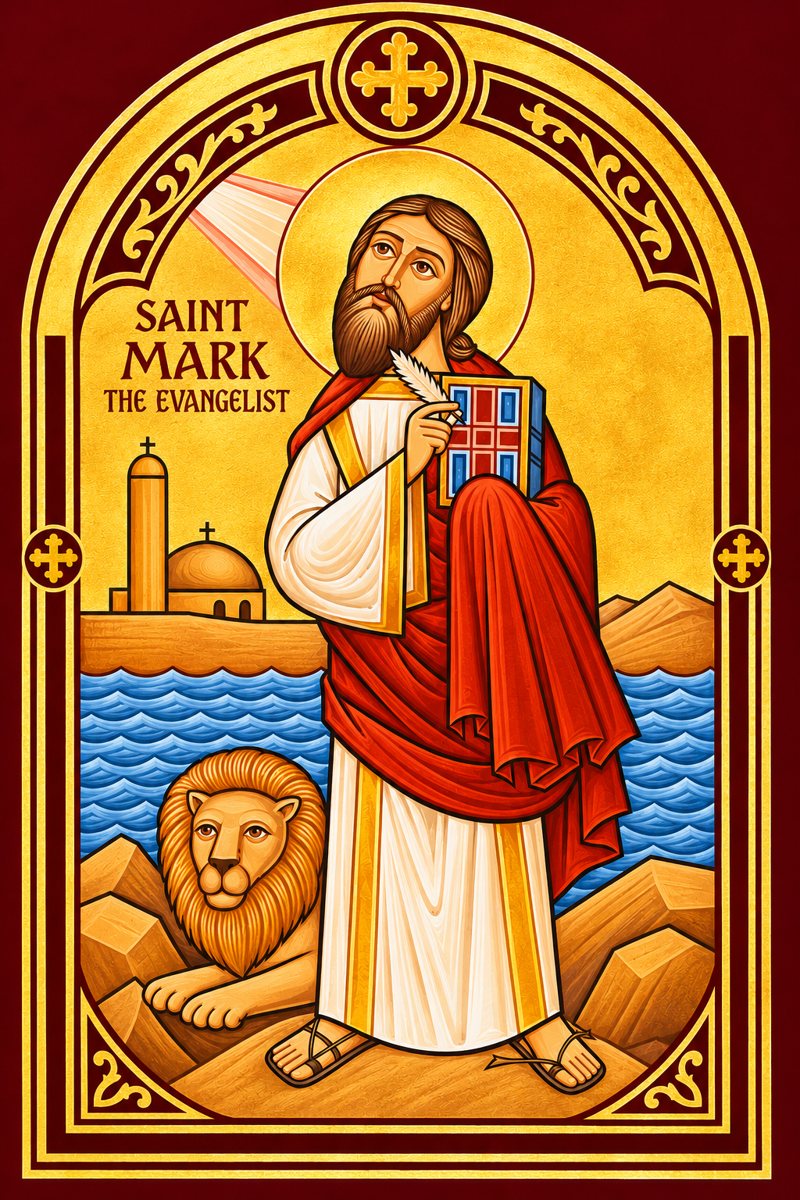
Coptic iconography from Fr. Tadros Y. Malaty’s booklet The Coptic Iconography. Every statement carries a footnote with its page.
Icons and the Life of the Church
Fr. Tadros Malaty writes that Coptic iconography is not only a branch of art but a window on Coptic spirituality, reflecting the life of the whole Church: communion with the heavenly hosts, victory over the demons, and the lifting of hearts to heaven.1 Following the School of Alexandria’s teaching of the oneness of life, icons express the one life a believer lives at home, in church, at school and at work.2 Art has been joined to worship from the beginning, because words alone cannot express man’s response to God’s love; early Copts carved Christian symbols on rings, walls, doors and household things, such as a fifth-century ivory comb in the Coptic Museum showing the raising of Lazarus.3 God loves the whole person and sanctifies body, life and culture, so that art can become an instrument of righteousness for the building up of the Church.4
- Fr. Tadros Y. Malaty, The Coptic Iconography (n.p., n.d.), PDF p. 2.
- Malaty, Coptic Iconography, PDF p. 2.
- Malaty, Coptic Iconography, PDF p. 2–3.
- Malaty, Coptic Iconography, PDF p. 3.
A Disputed Art
Scholars have disagreed about Coptic art: some called it a continuation of Hellenistic art, others an offshoot of Byzantine art, others an authentic national Egyptian art.5 Part of the difficulty is that Egypt was ruled by Greeks, Romans and Byzantines who left their own monuments, and that the finest Coptic works were destroyed in persecutions, so that only smaller chapels kept their paintings.6
- Malaty, Coptic Iconography, PDF p. 3.
- Malaty, Coptic Iconography, PDF p. 3.
Influences on Coptic Art
The School of Alexandria shaped Coptic iconography: its deans, such as Pantaenus and Clement, embraced and Christianized the cultures around them, and its search for the hidden meaning of Scripture became a search for the inner meaning of icons.7 Its ecumenical spirit made Coptic artists open to other peoples’ art; Greek and Egyptian styles appear together in one icon, alongside Persian, Byzantine and Syrian influences.8 Although some scholars saw Coptic art as Hellenistic, Fr. Tadros Malaty concludes that it has its own character, influenced by foreign styles but not dependent on them; Herbert Read wrote that the Christian art of Egypt “is still Egyptian.”9 Monasticism, a purely Egyptian institution, helped de-Hellenize Coptic art in the fourth century, especially in the monasteries of Saint Shenouda the Archimandrite.10 Exchanges with Byzantium left traces in both directions, as in the sixth-century icon of Christ protecting Saint Mena, which joins Byzantine details to Egyptian features, an Egyptian landscape and a red sunset sky.11 After the Council of Chalcedon and the persecutions that followed, a national “Coptic” feeling arose; after the Arab conquest, links with Byzantium and Rome ended and textiles flourished while many paintings were lost.12
- Malaty, Coptic Iconography, PDF p. 4.
- Malaty, Coptic Iconography, PDF p. 4–5.
- Malaty, Coptic Iconography, PDF p. 5.
- Malaty, Coptic Iconography, PDF p. 7.
- Malaty, Coptic Iconography, PDF p. 7–8.
- Malaty, Coptic Iconography, PDF p. 8.
The Neo-Coptic School
Otto Meinardus describes how, after centuries of Byzantine and then Western influence, a new sense of Coptic identity in the mid-twentieth century, under Pope Cyril VI and Pope Shenouda III, gave rise to a Neo-Coptic school of art that deliberately turned away from Byzantine and Western forms.13 Fr. Tadros Malaty asks iconographers not to copy ancient icons mechanically but to enter into their spirit and keep the character of Coptic art in a modern way.14
- Malaty, Coptic Iconography, PDF p. 8.
- Malaty, Coptic Iconography, PDF p. 9.
The Character of Coptic Icons
Coptic icons reveal the Church’s mind, teaching and spirituality: they show joyful life, victory, love and kindness, strength of spirit, prayer, the bearing of the Cross, God’s providence, inner sight, and the military saints.15
- Malaty, Coptic Iconography, PDF p. 9–10.
Coptic Art and the World
Through the School of Alexandria and the desert monks, Coptic art spread to Ethiopia, Nubia and beyond; a likeness has been noted between Coptic and Celtic decoration, perhaps through Egyptian monks who preached in Ireland.16 The image of Christ trampling the lion and the serpent, known in early French art, is traced to Egypt, and Alexandrian painters influenced the workshops of Constantinople and Western painting.17
- Malaty, Coptic Iconography, PDF p. 10.
- Malaty, Coptic Iconography, PDF p. 10.
Sources
- Malaty, Fr. Tadros Y. The Coptic Iconography. No place or date printed. The booklet has no printed page numbers; pages are those of the PDF copy.
How to cite this page
Saint Peter & Saint Andrew Coptic Orthodox Church, Stamford, Connecticut. “Coptic Iconography.” SPSA.church. https://spsa.church/coptic-church/coptic-iconography/.
To quote a fact, cite the book and page given in its note.