Writer & teacher
From Fr. Tadros’s book
BIOGRAPHY
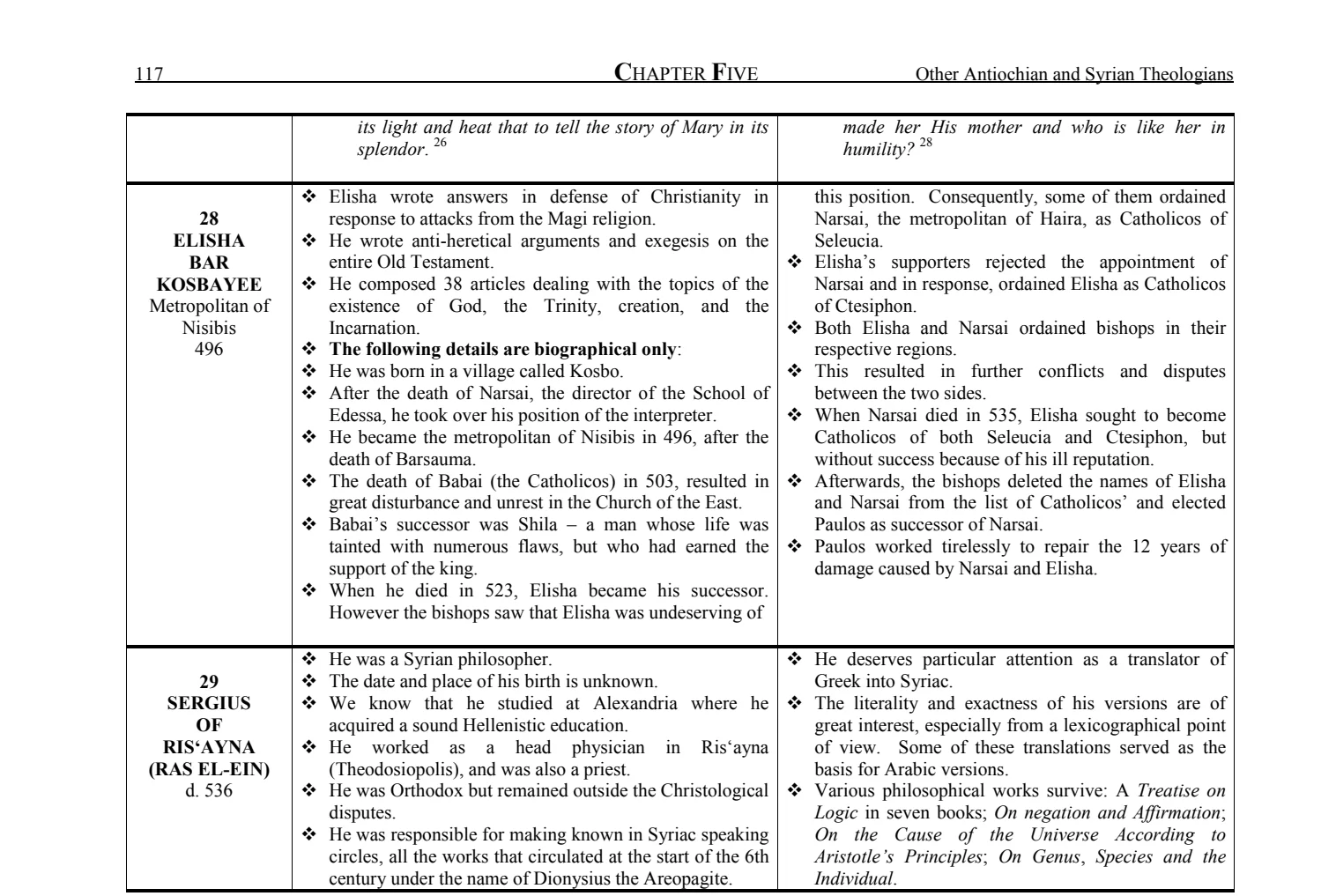
- Elisha wrote answers in defense of Christianity in response to attacks from the Magi religion.
- He wrote anti-heretical arguments and exegesis on the entire Old Testament.
- He composed 38 articles dealing with the topics of the existence of God, the Trinity, creation, and the Incarnation.
- The following details are biographical only:
- He was born in a village called Kosbo.
- After the death of Narsai, the director of the School of Edessa, he took over his position of the interpreter.
- He became the metropolitan of Nisibis in 496, after the death of Barsauma.
- The death of Babai (the Catholicos) in 503, resulted in great disturbance and unrest in the Church of the East.
- Babai’s successor was Shila – a man whose life was tainted with numerous flaws, but who had earned the support of the king.
- When he died in 523, Elisha became his successor. However the bishops saw that Elisha was undeserving of
WRITINGS
this position. Consequently, some of them ordained Narsai, the metropolitan of Haira, as Catholicos of Seleucia.
- Elisha’s supporters rejected the appointment of Narsai and in response, ordained Elisha as Catholicos of Ctesiphon.
- Both Elisha and Narsai ordained bishops in their respective regions.
- This resulted in further conflicts and disputes between the two sides.
- When Narsai died in 535, Elisha sought to become Catholicos of both Seleucia and Ctesiphon, but without success because of his ill reputation.
- Afterwards, the bishops deleted the names of Elisha and Narsai from the list of Catholicos’ and elected Paulos as successor of Narsai.
- Paulos worked tirelessly to repair the 12 years of damage caused by Narsai and Elisha.
From A Panoramic View of Patristics by Hegumen Fr. Tadros Yacoub Malaty (Preparatory edition, February 2005, St George’s Coptic Orthodox Church, Sporting, Alexandria).
Chapter 5, Other Antiochian and Syrian theologians, pp. 117–118
Original book pages (1)