Writer & teacher
From Fr. Tadros’s book
BIOGRAPHY
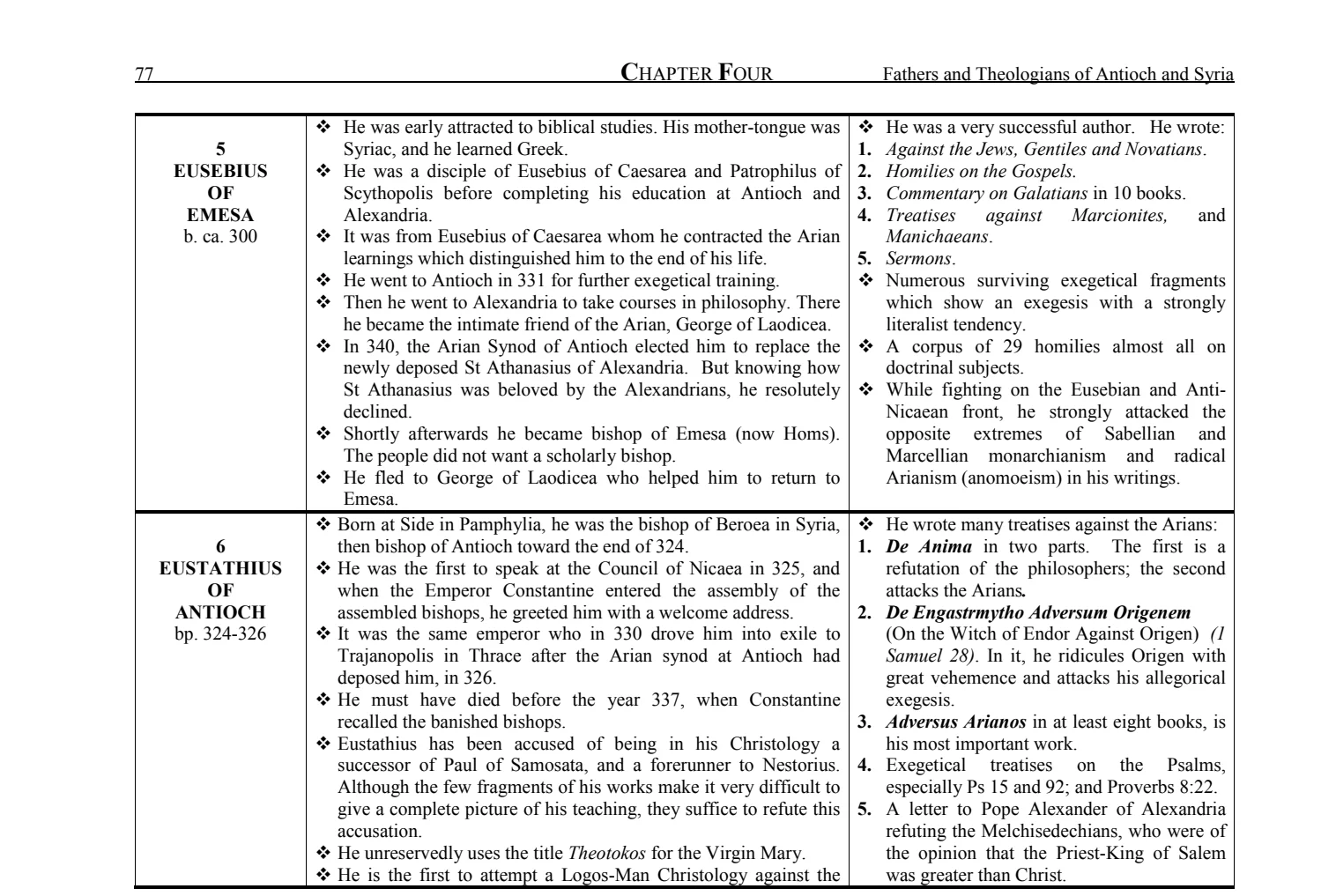
- He was early attracted to biblical studies. His mother-tongue was Syriac, and he learned Greek.
- He was a disciple of Eusebius of Caesarea and Patrophilus of Scythopolis before completing his education at Antioch and Alexandria.
- It was from Eusebius of Caesarea whom he contracted the Arian learnings which distinguished him to the end of his life.
- He went to Antioch in 331 for further exegetical training.
- Then he went to Alexandria to take courses in philosophy. There he became the intimate friend of the Arian, George of Laodicea.
- In 340, the Arian Synod of Antioch elected him to replace the newly deposed St Athanasius of Alexandria. But knowing how St Athanasius was beloved by the Alexandrians, he resolutely declined.
- Shortly afterwards he became bishop of Emesa (now Homs). The people did not want a scholarly bishop.
- He fled to George of Laodicea who helped him to return to Emesa.
MAIN WRITINGS
- He was a very successful author. He wrote:
1. Against the Jews, Gentiles and Novatians.
2. Homilies on the Gospels.
3. Commentary on Galatians in 10 books.
4. Treatises against Marcionites, and Manichaeans.
5. Sermons.
- Numerous surviving exegetical fragments which show an exegesis with a strongly literalist tendency.
- A corpus of 29 homilies almost all on doctrinal subjects.
- While fighting on the Eusebian and Anti-Nicaean front, he strongly attacked the opposite extremes of Sabellian and Marcellian monarchianism and radical Arianism (anomoeism) in his writings.
From A Panoramic View of Patristics by Hegumen Fr. Tadros Yacoub Malaty (Preparatory edition, February 2005, St George’s Coptic Orthodox Church, Sporting, Alexandria).
Chapter 4, Antioch and Syria, pp. 77–78
Original book pages (1)