Historical context
Historical context. Read Fr. Tadros’s assessment of this person’s teachings in context.
From Fr. Tadros’s book
BIOGRAPHY
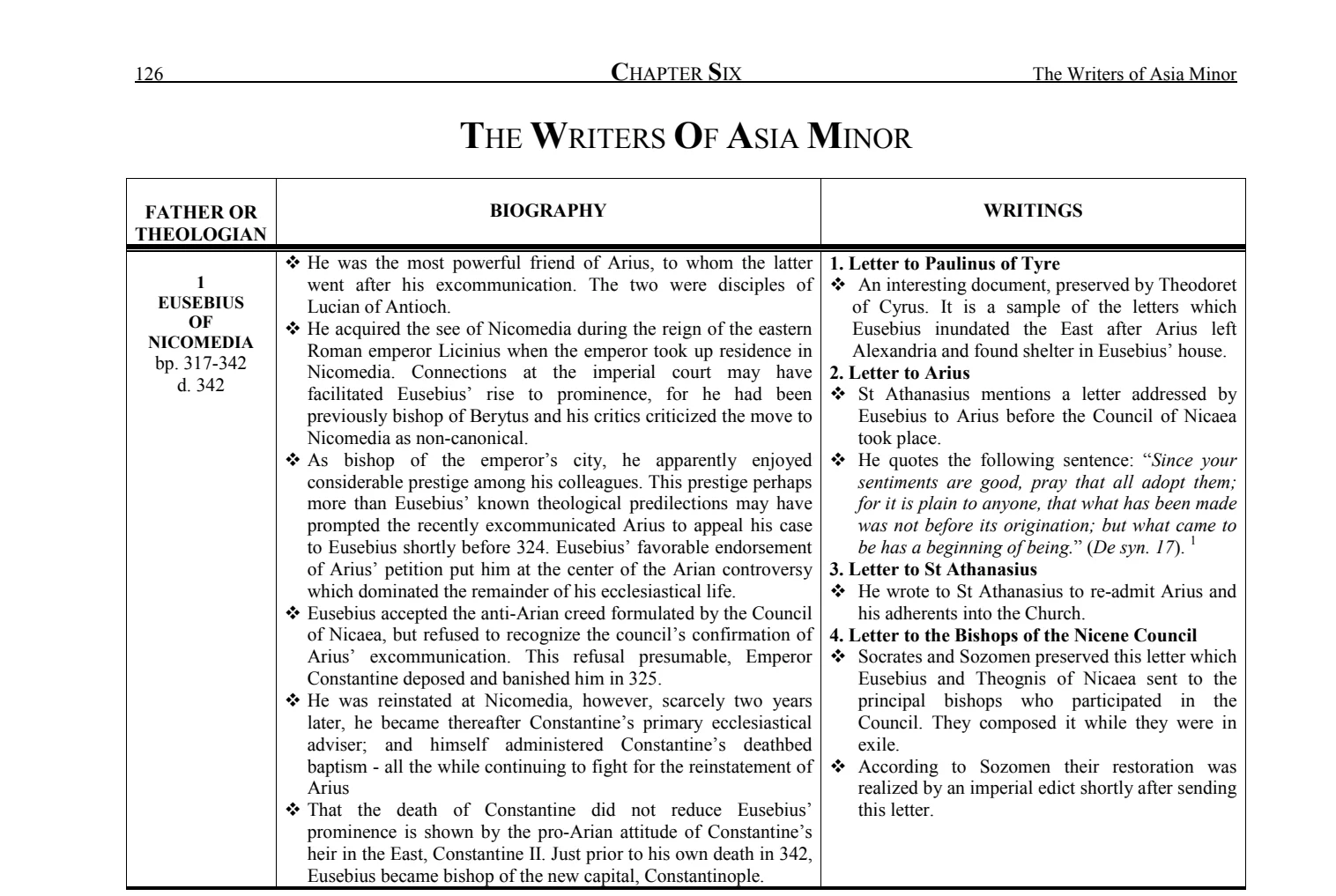
- He was the most powerful friend of Arius, to whom the latter went after his excommunication. The two were disciples of Lucian of Antioch.
- He acquired the see of Nicomedia during the reign of the eastern Roman emperor Licinius when the emperor took up residence in Nicomedia. Connections at the imperial court may have facilitated Eusebius’ rise to prominence, for he had been previously bishop of Berytus and his critics criticized the move to Nicomedia as non-canonical.
- As bishop of the emperor’s city, he apparently enjoyed considerable prestige among his colleagues. This prestige perhaps more than Eusebius’ known theological predilections may have prompted the recently excommunicated Arius to appeal his case to Eusebius shortly before 324. Eusebius’ favorable endorsement of Arius’ petition put him at the center of the Arian controversy which dominated the remainder of his ecclesiastical life.
- Eusebius accepted the anti-Arian creed formulated by the Council of Nicaea, but refused to recognize the council’s confirmation of Arius’ excommunication. This refusal presumable, Emperor Constantine deposed and banished him in 325.
- He was reinstated at Nicomedia, however, scarcely two years later, he became thereafter Constantine’s primary ecclesiastical adviser; and himself administered Constantine’s deathbed baptism - all the while continuing to fight for the reinstatement of Arius
- That the death of Constantine did not reduce Eusebius’ prominence is shown by the pro-Arian attitude of Constantine’s heir in the East, Constantine II. Just prior to his own death in 342, Eusebius became bishop of the new capital, Constantinople.
WRITINGS
1. Letter to Paulinus of Tyre
- An interesting document, preserved by Theodoret of Cyrus. It is a sample of the letters which Eusebius inundated the East after Arius left Alexandria and found shelter in Eusebius’ house.
2. Letter to Arius
- St Athanasius mentions a letter addressed by Eusebius to Arius before the Council of Nicaea took place.
- He quotes the following sentence: “Since your sentiments are good, pray that all adopt them; for it is plain to anyone, that what has been made was not before its origination; but what came to be has a beginning of being.” (De syn. 17). 1
3. Letter to St Athanasius
- He wrote to St Athanasius to re-admit Arius and his adherents into the Church.
4. Letter to the Bishops of the Nicene Council
- Socrates and Sozomen preserved this letter which Eusebius and Theognis of Nicaea sent to the principal bishops who participated in the Council. They composed it while they were in exile.
- According to Sozomen their restoration was realized by an imperial edict shortly after sending this letter.
From A Panoramic View of Patristics by Hegumen Fr. Tadros Yacoub Malaty (Preparatory edition, February 2005, St George’s Coptic Orthodox Church, Sporting, Alexandria).
Chapter 6, Writers of Asia Minor, pp. 126–127
Original book pages (1)