Writer & teacher
From Fr. Tadros’s book
BIOGRAPHY
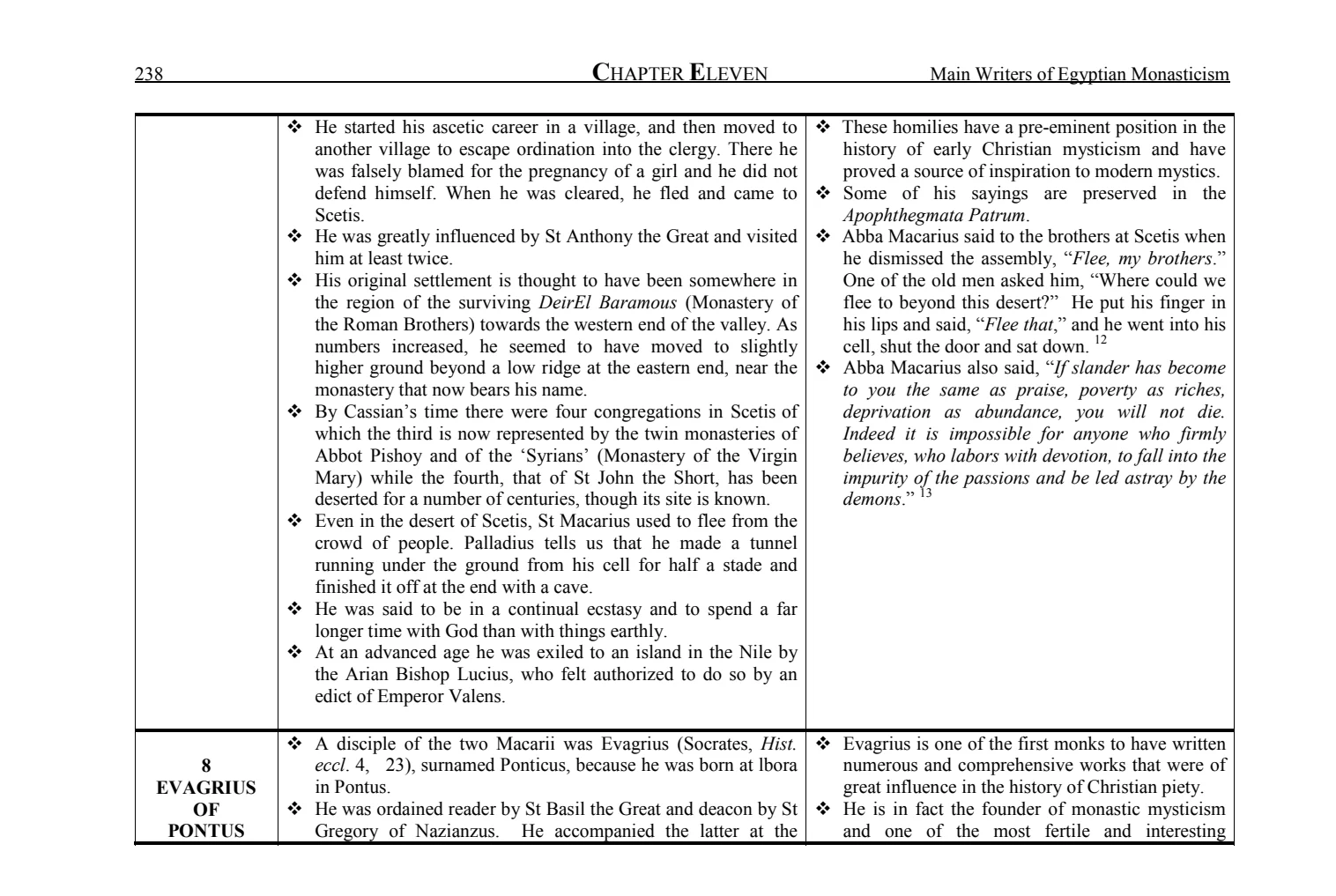
- A disciple of the two Macarii was Evagrius (Socrates, Hist. eccl. 4, 23), surnamed Ponticus, because he was born at lbora in Pontus.
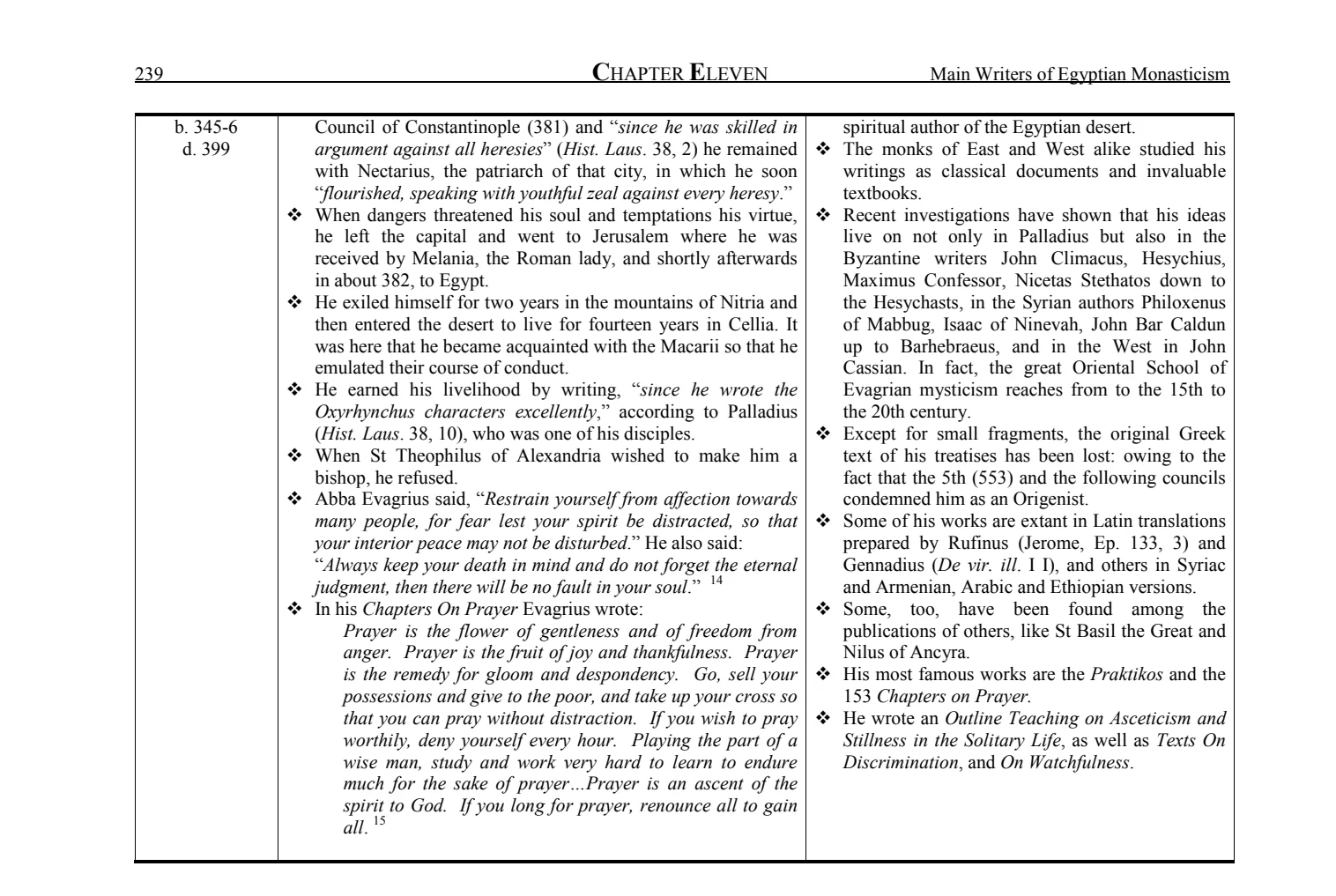
- He was ordained reader by St Basil the Great and deacon by St Gregory of Nazianzus. He accompanied the latter at the Council of Constantinople (381) and “since he was skilled in argument against all heresies” (Hist. Laus. 38, 2) he remained with Nectarius, the patriarch of that city, in which he soon “flourished, speaking with youthful zeal against every heresy.”
- When dangers threatened his soul and temptations his virtue, he left the capital and went to Jerusalem where he was received by Melania, the Roman lady, and shortly afterwards in about 382, to Egypt.
- He exiled himself for two years in the mountains of Nitria and then entered the desert to live for fourteen years in Cellia. It was here that he became acquainted with the Macarii so that he emulated their course of conduct.
- He earned his livelihood by writing, “since he wrote the Oxyrhynchus characters excellently,” according to Palladius (Hist. Laus. 38, 10), who was one of his disciples.
- When St Theophilus of Alexandria wished to make him a bishop, he refused.
- Abba Evagrius said, “Restrain yourself from affection towards many people, for fear lest your spirit be distracted, so that your interior peace may not be disturbed.” He also said: “Always keep your death in mind and do not forget the eternal judgment, then there will be no fault in your soul.” 14
- In his Chapters On Prayer Evagrius wrote: Prayer is the flower of gentleness and of freedom from anger. Prayer is the fruit of joy and thankfulness. Prayer is the remedy for gloom and despondency. Go, sell your possessions and give to the poor, and take up your cross so that you can pray without distraction. If you wish to pray worthily, deny yourself every hour. Playing the part of a wise man, study and work very hard to learn to endure much for the sake of prayer…Prayer is an ascent of the spirit to God. If you long for prayer, renounce all to gain all. 15
WRITINGS AND THOUGHTS
- Evagrius is one of the first monks to have written numerous and comprehensive works that were of great influence in the history of Christian piety.
- He is in fact the founder of monastic mysticism and one of the most fertile and interesting spiritual author of the Egyptian desert.
- The monks of East and West alike studied his writings as classical documents and invaluable textbooks.
- Recent investigations have shown that his ideas live on not only in Palladius but also in the Byzantine writers John Climacus, Hesychius, Maximus Confessor, Nicetas Stethatos down to the Hesychasts, in the Syrian authors Philoxenus of Mabbug, Isaac of Ninevah, John Bar Caldun up to Barhebraeus, and in the West in John Cassian. In fact, the great Oriental School of Evagrian mysticism reaches from to the 15th to the 20th century.
- Except for small fragments, the original Greek text of his treatises has been lost: owing to the fact that the 5th (553) and the following councils condemned him as an Origenist.
- Some of his works are extant in Latin translations prepared by Rufinus (Jerome, Ep. 133, 3) and Gennadius (De vir. ill. I I), and others in Syriac and Armenian, Arabic and Ethiopian versions.
- Some, too, have been found among the publications of others, like St Basil the Great and Nilus of Ancyra.
- His most famous works are the Praktikos and the 153 Chapters on Prayer.
- He wrote an Outline Teaching on Asceticism and Stillness in the Solitary Life, as well as Texts On Discrimination, and On Watchfulness.
From A Panoramic View of Patristics by Hegumen Fr. Tadros Yacoub Malaty (Preparatory edition, February 2005, St George’s Coptic Orthodox Church, Sporting, Alexandria).
Chapter 11, Egyptian monasticism, pp. 238–240