Writer & teacher
From Fr. Tadros’s book
BIOGRAPHY
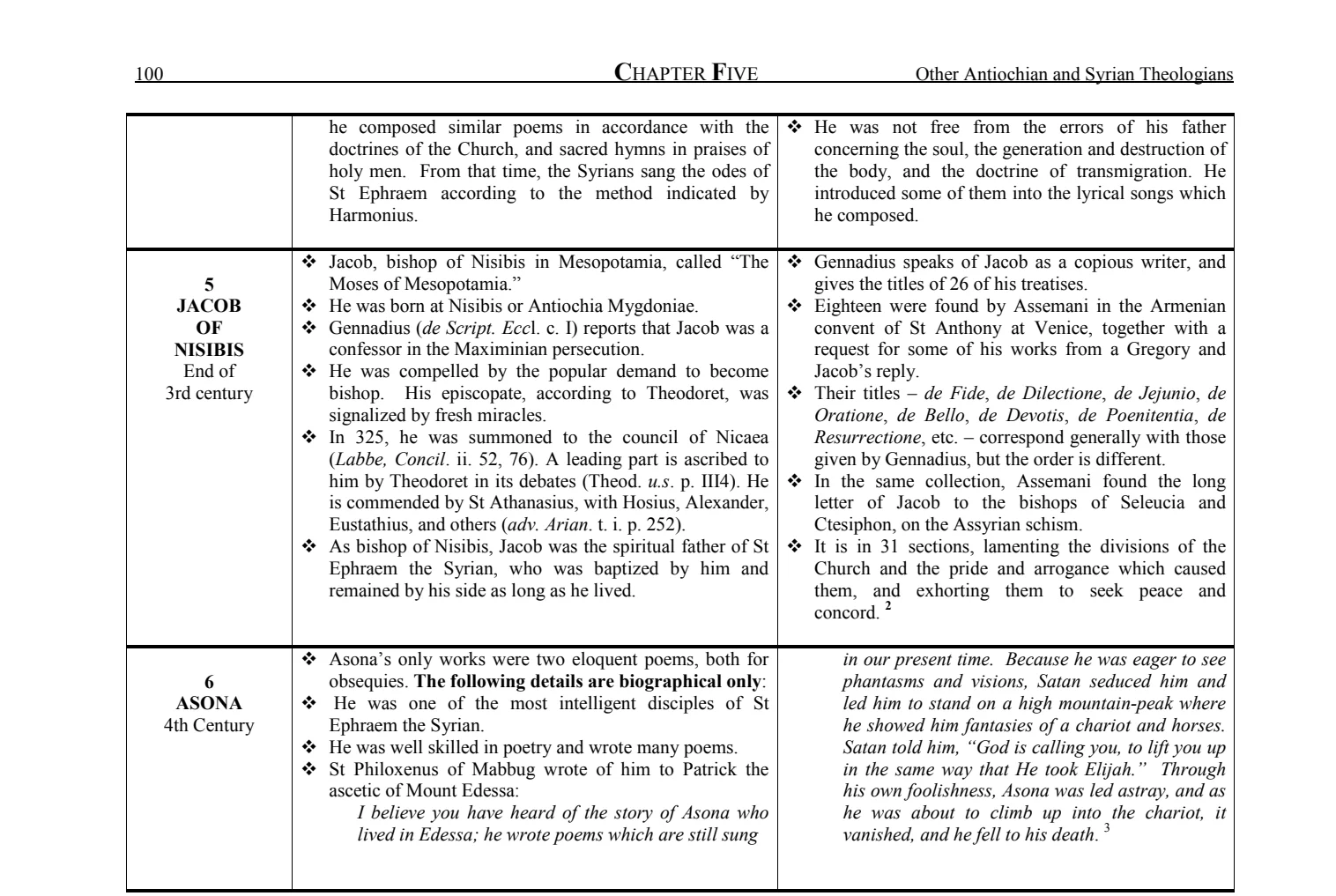
- Jacob, bishop of Nisibis in Mesopotamia, called “The Moses of Mesopotamia.”
- He was born at Nisibis or Antiochia Mygdoniae.
- Gennadius (de Script. Eccl. c. I) reports that Jacob was a confessor in the Maximinian persecution.
- He was compelled by the popular demand to become bishop. His episcopate, according to Theodoret, was signalized by fresh miracles.
- In 325, he was summoned to the council of Nicaea (Labbe, Concil. ii. 52, 76). A leading part is ascribed to him by Theodoret in its debates (Theod. u.s. p. III4). He is commended by St Athanasius, with Hosius, Alexander, Eustathius, and others (adv. Arian. t. i. p. 252).
- As bishop of Nisibis, Jacob was the spiritual father of St Ephraem the Syrian, who was baptized by him and remained by his side as long as he lived.
WRITINGS
- Gennadius speaks of Jacob as a copious writer, and gives the titles of 26 of his treatises.
- Eighteen were found by Assemani in the Armenian convent of St Anthony at Venice, together with a request for some of his works from a Gregory and Jacob’s reply.
- Their titles – de Fide, de Dilectione, de Jejunio, de Oratione, de Bello, de Devotis, de Poenitentia, de Resurrectione, etc. – correspond generally with those given by Gennadius, but the order is different.
- In the same collection, Assemani found the long letter of Jacob to the bishops of Seleucia and Ctesiphon, on the Assyrian schism.
- It is in 31 sections, lamenting the divisions of the Church and the pride and arrogance which caused them, and exhorting them to seek peace and concord. 2
From A Panoramic View of Patristics by Hegumen Fr. Tadros Yacoub Malaty (Preparatory edition, February 2005, St George’s Coptic Orthodox Church, Sporting, Alexandria).
Chapter 5, Other Antiochian and Syrian theologians, pp. 100–101
Original book pages (1)