Historical context
Historical context. Read Fr. Tadros’s assessment of this person’s teachings in context.
From Fr. Tadros’s book
MAIN DOCTRINES
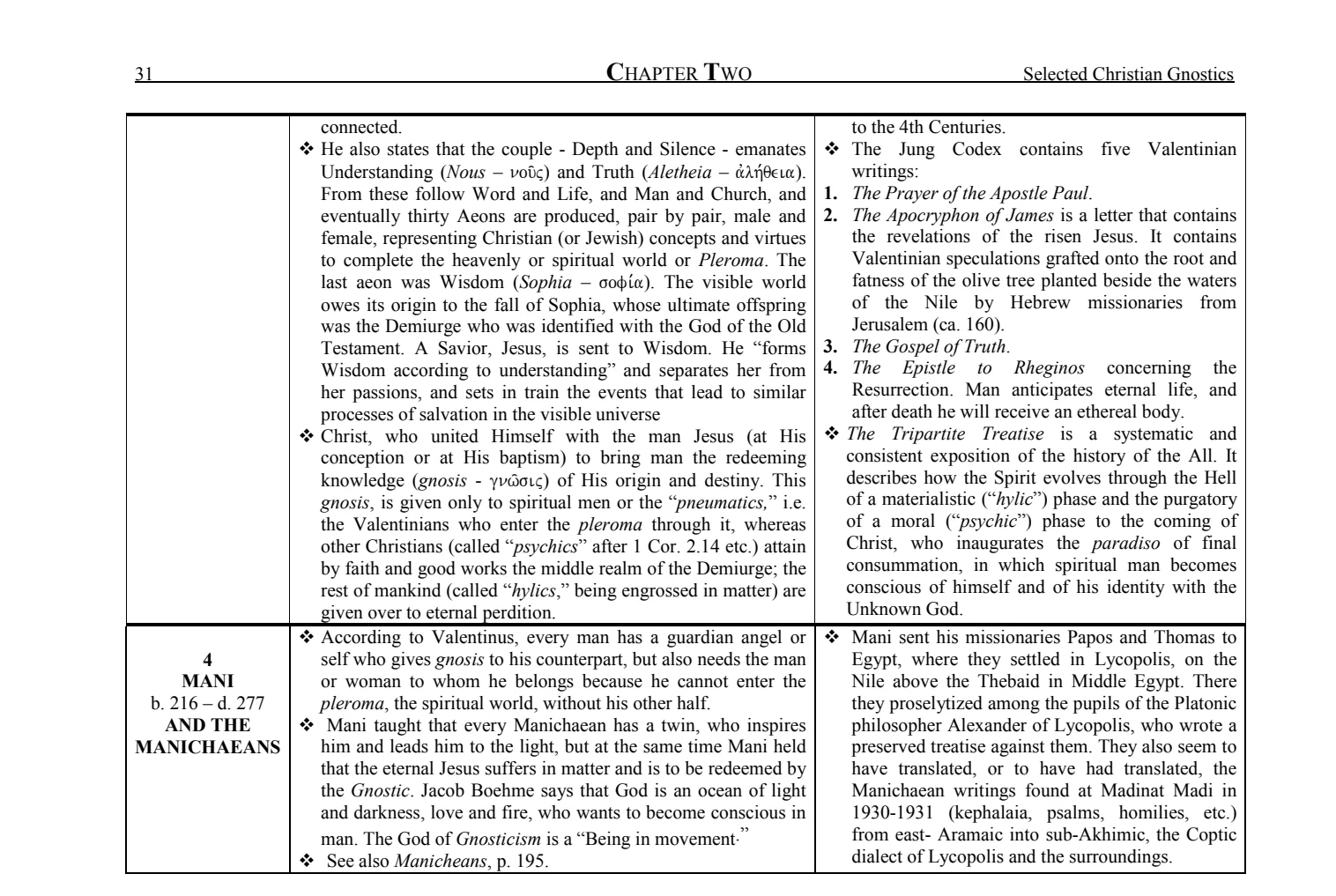
- According to Valentinus, every man has a guardian angel or self who gives gnosis to his counterpart, but also needs the man or woman to whom he belongs because he cannot enter the pleroma, the spiritual world, without his other half.
- Mani taught that every Manichaean has a twin, who inspires him and leads him to the light, but at the same time Mani held that the eternal Jesus suffers in matter and is to be redeemed by the Gnostic. Jacob Boehme says that God is an ocean of light and darkness, love and fire, who wants to become conscious in man. The God of Gnosticism is a “Being in movement.”
- See also Manicheans, p. 195.
REMARKS
- Mani sent his missionaries Papos and Thomas to Egypt, where they settled in Lycopolis, on the Nile above the Thebaid in Middle Egypt. There they proselytized among the pupils of the Platonic philosopher Alexander of Lycopolis, who wrote a preserved treatise against them. They also seem to have translated, or to have had translated, the Manichaean writings found at Madinat Madi in 1930-1931 (kephalaia, psalms, homilies, etc.) from east-Aramaic into sub-Akhimic, the Coptic dialect of Lycopolis and the surroundings.
From A Panoramic View of Patristics by Hegumen Fr. Tadros Yacoub Malaty (Preparatory edition, February 2005, St George’s Coptic Orthodox Church, Sporting, Alexandria).
Chapter 2, Gnostic teachers — historical context, p. 31
Original book pages (1)