Writer & teacher
From Fr. Tadros’s book
BIOGRAPHY
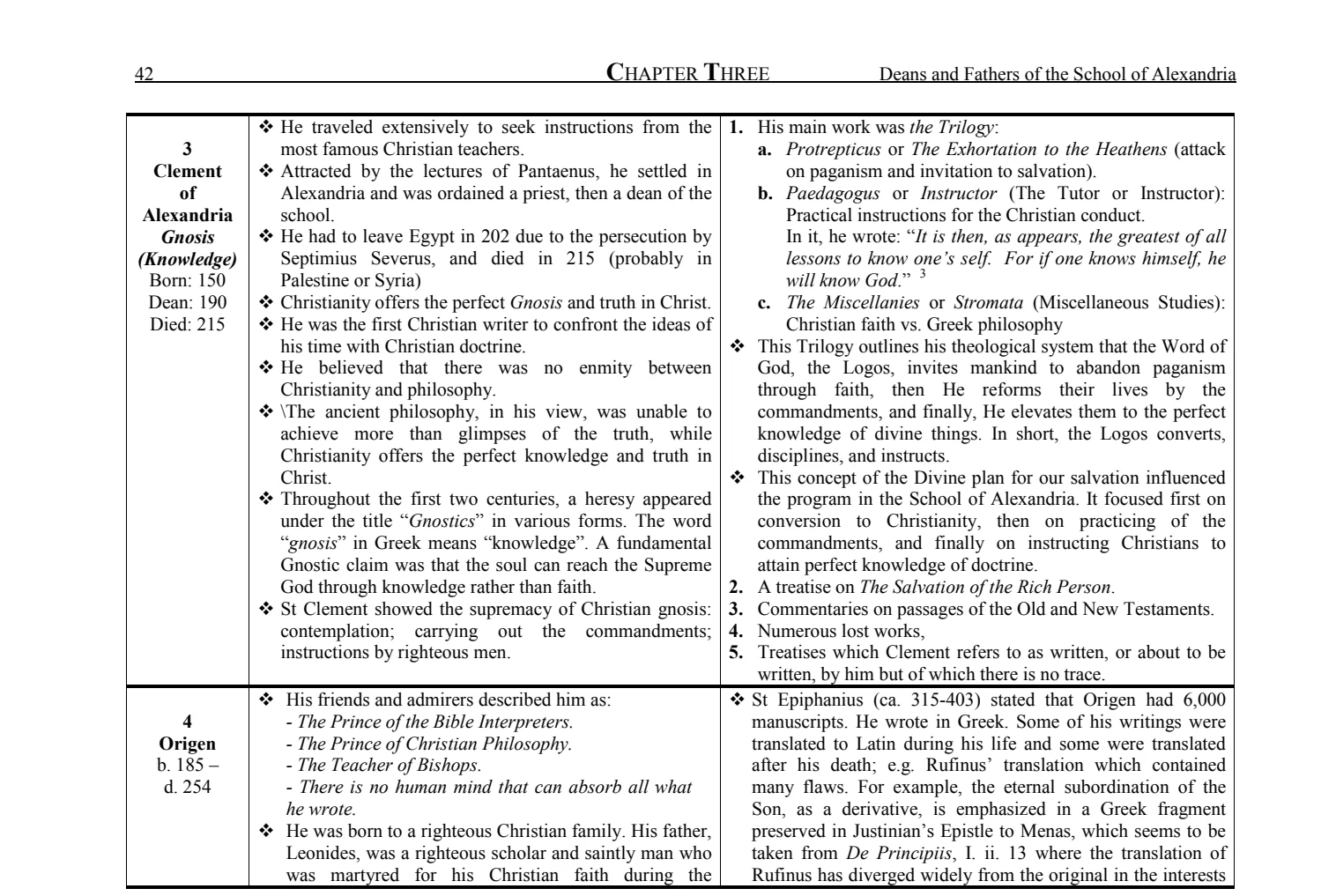
- His friends and admirers described him as: - The Prince of the Bible Interpreters. - The Prince of Christian Philosophy. - The Teacher of Bishops. - There is no human mind that can absorb all what he wrote.
- He was born to a righteous Christian family. His father, Leonides, was a righteous scholar and saintly man who was martyred for his Christian faith during the persecution of Septimius Severus, 202. While his father was in jail, Origen wrote encouraging him to face martyrdom.
- He rented libraries overnight to read their books. St Jerome praised his love of reading and said that Origen read while eating, walking, resting, etc. Thus his knowledge extended beyond measures and his intellectual superiority was undisputed. He worked in teaching.
- When Pope Demetrius (12th Pope of Alexandria) heard of his fame, he appointed him dean of the School of Alexandria. He increased its fame and thought and became a teacher of many bishops and priests, as well as many men, women, young and old. First, he rented halls to hold the school, but when he was chased from one place to another, he held his lectures outdoors (in the open or beside the river).
- He was famous in allegorical interpretation. For example, his interpretation of the Song of Songs (differs from St Basil’s school of literal interpretation).
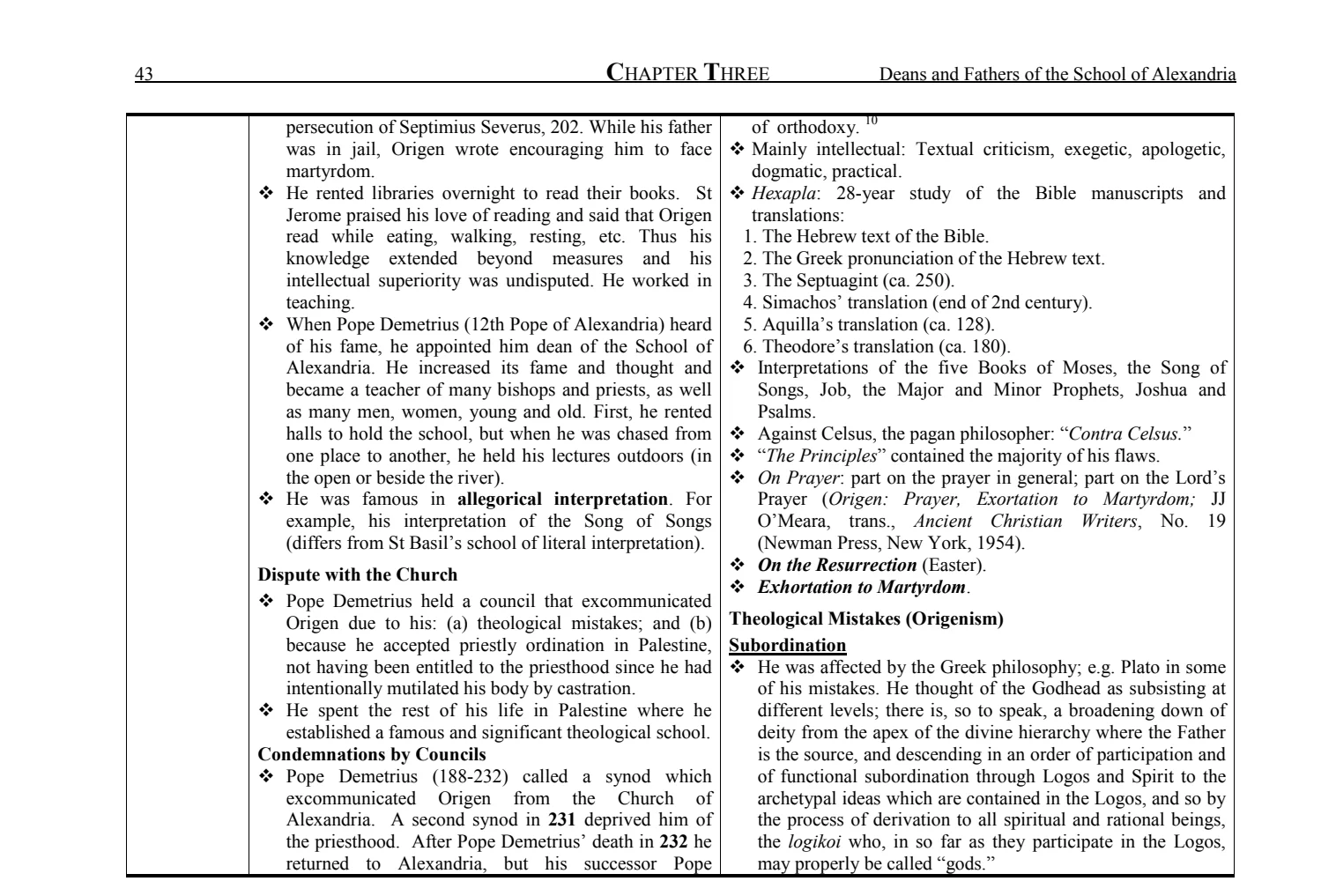
Dispute with the Church
- Pope Demetrius held a council that excommunicated Origen due to his: (a) theological mistakes; and (b) because he accepted priestly ordination in Palestine, not having been entitled to the priesthood since he had intentionally mutilated his body by castration.
- He spent the rest of his life in Palestine where he established a famous and significant theological school.
Condemnations by Councils
- Pope Demetrius (188-232) called a synod which excommunicated Origen from the Church of Alexandria. A second synod in 231 deprived him of the priesthood. After Pope Demetrius’ death in 232 he returned to Alexandria, but his successor Pope Heraclas, Origen’s former assistant, repeated the excommunication.
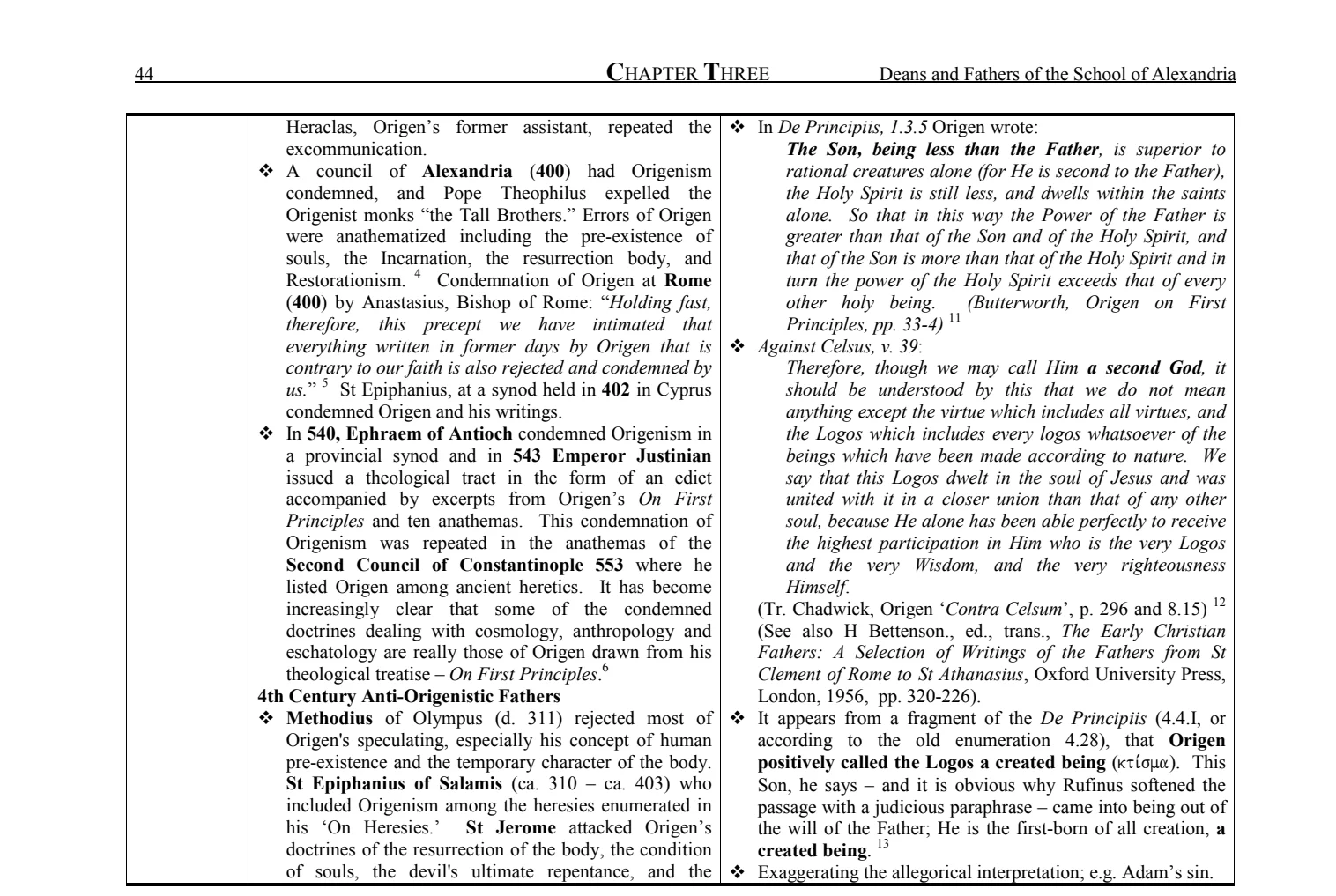
- A council of Alexandria (400) had Origenism condemned, and Pope Theophilus expelled the Origenist monks “the Tall Brothers.” Errors of Origen were anathematized including the pre-existence of souls, the Incarnation, the resurrection body, and Restorationism. 4 Condemnation of Origen at Rome (400) by Anastasius, Bishop of Rome: “Holding fast, therefore, this precept we have intimated that everything written in former days by Origen that is contrary to our faith is also rejected and condemned by us.” 5 St Epiphanius, at a synod held in 402 in Cyprus condemned Origen and his writings.
- In 540, Ephraem of Antioch condemned Origenism in a provincial synod and in 543 Emperor Justinian issued a theological tract in the form of an edict accompanied by excerpts from Origen’s On First Principles and ten anathemas. This condemnation of Origenism was repeated in the anathemas of the Second Council of Constantinople 553 where he listed Origen among ancient heretics. It has become increasingly clear that some of the condemned doctrines dealing with cosmology, anthropology and eschatology are really those of Origen drawn from his theological treatise – On First Principles.6
4th Century Anti-Origenistic Fathers
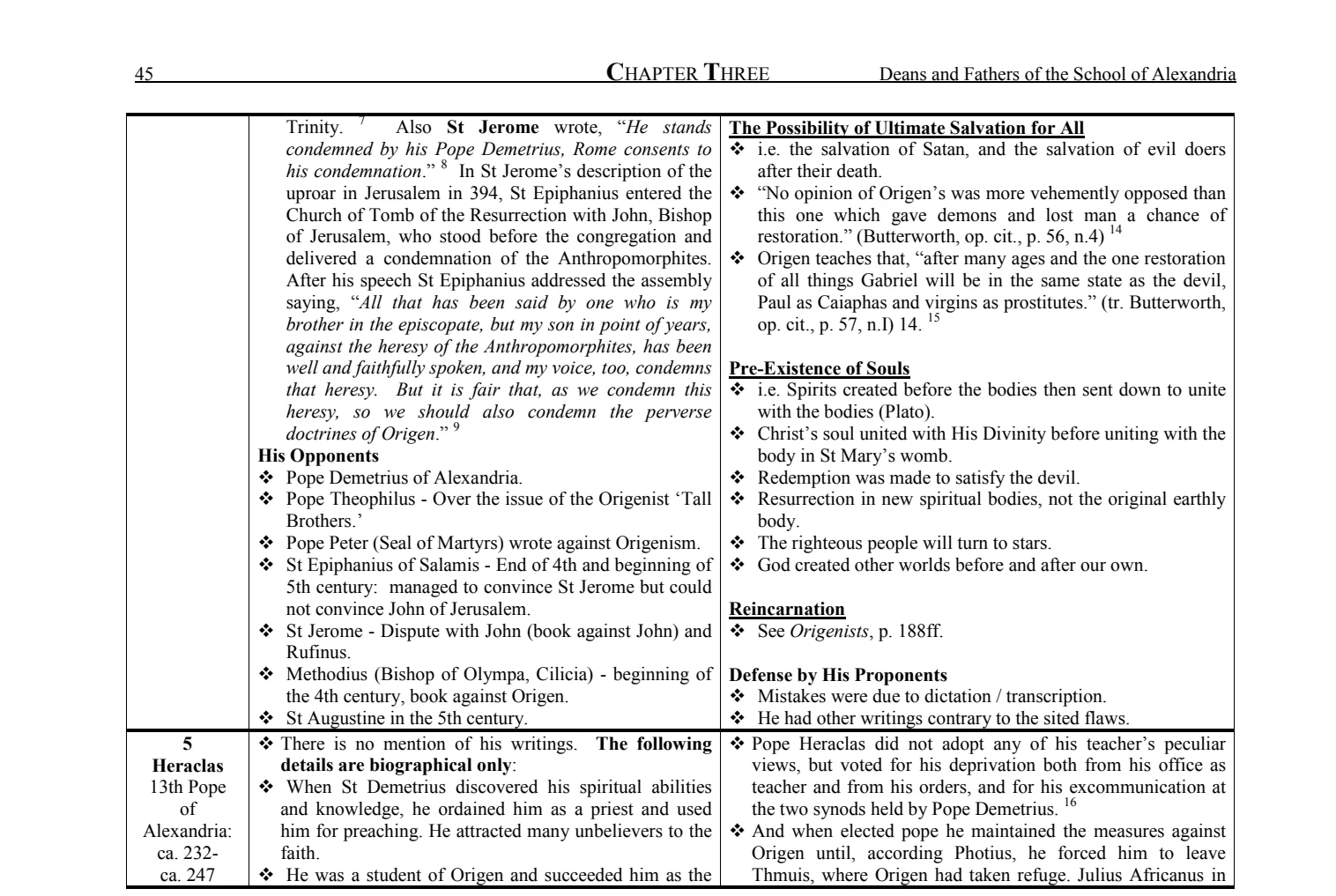
- Methodius of Olympus (d. 311) rejected most of Origen's speculating, especially his concept of human pre-existence and the temporary character of the body. St Epiphanius of Salamis (ca. 310 – ca. 403) who included Origenism among the heresies enumerated in his ‘On Heresies.’ St Jerome attacked Origen’s doctrines of the resurrection of the body, the condition of souls, the devil's ultimate repentance, and the Trinity. 7 Also St Jerome wrote, “He stands condemned by his Pope Demetrius, Rome consents to his condemnation.” 8 In St Jerome’s description of the uproar in Jerusalem in 394, St Epiphanius entered the Church of Tomb of the Resurrection with John, Bishop of Jerusalem, who stood before the congregation and delivered a condemnation of the Anthropomorphites. After his speech St Epiphanius addressed the assembly saying, “All that has been said by one who is my brother in the episcopate, but my son in point of years, against the heresy of the Anthropomorphites, has been well and faithfully spoken, and my voice, too, condemns that heresy. But it is fair that, as we condemn this heresy, so we should also condemn the perverse doctrines of Origen.” 9
His Opponents
- Pope Demetrius of Alexandria.
- Pope Theophilus - Over the issue of the Origenist ‘Tall Brothers.’
- Pope Peter (Seal of Martyrs) wrote against Origenism.
- St Epiphanius of Salamis - End of 4th and beginning of 5th century: managed to convince St Jerome but could not convince John of Jerusalem.
- St Jerome - Dispute with John (book against John) and Rufinus.
- Methodius (Bishop of Olympa, Cilicia) - beginning of the 4th century, book against Origen.
- St Augustine in the 5th century.
WRITINGS AND THEOLOGY
- St Epiphanius (ca. 315-403) stated that Origen had 6,000 manuscripts. He wrote in Greek. Some of his writings were translated to Latin during his life and some were translated after his death; e.g. Rufinus’ translation which contained many flaws. For example, the eternal subordination of the Son, as a derivative, is emphasized in a Greek fragment preserved in Justinian’s Epistle to Menas, which seems to be taken from De Principiis, I. ii. 13 where the translation of Rufinus has diverged widely from the original in the interests of orthodoxy. 10
- Mainly intellectual: Textual criticism, exegetic, apologetic, dogmatic, practical.
- Hexapla: 28-year study of the Bible manuscripts and translations:
1. The Hebrew text of the Bible.
2. The Greek pronunciation of the Hebrew text.
3. The Septuagint (ca. 250).
4. Simachos’ translation (end of 2nd century).
5. Aquilla’s translation (ca. 128).
6. Theodore’s translation (ca. 180).
- Interpretations of the five Books of Moses, the Song of Songs, Job, the Major and Minor Prophets, Joshua and Psalms.
- Against Celsus, the pagan philosopher: “Contra Celsus.”
- “The Principles” contained the majority of his flaws.
- On Prayer: part on the prayer in general; part on the Lord’s Prayer (Origen: Prayer, Exortation to Martyrdom; JJ O’Meara, trans., Ancient Christian Writers, No. 19 (Newman Press, New York, 1954).
- On the Resurrection (Easter).
- Exhortation to Martyrdom.
Theological Mistakes (Origenism) Subordination
- He was affected by the Greek philosophy; e.g. Plato in some of his mistakes. He thought of the Godhead as subsisting at different levels; there is, so to speak, a broadening down of deity from the apex of the divine hierarchy where the Father is the source, and descending in an order of participation and of functional subordination through Logos and Spirit to the archetypal ideas which are contained in the Logos, and so by the process of derivation to all spiritual and rational beings, the logikoi who, in so far as they participate in the Logos, may properly be called “gods.”
- In De Principiis, 1.3.5 Origen wrote: The Son, being less than the Father, is superior to rational creatures alone (for He is second to the Father), the Holy Spirit is still less, and dwells within the saints alone. So that in this way the Power of the Father is greater than that of the Son and of the Holy Spirit, and that of the Son is more than that of the Holy Spirit and in turn the power of the Holy Spirit exceeds that of every other holy being. (Butterworth, Origen on First Principles, pp. 33-4) 11
- Against Celsus, v. 39: Therefore, though we may call Him a second God, it should be understood by this that we do not mean anything except the virtue which includes all virtues, and the Logos which includes every logos whatsoever of the beings which have been made according to nature. We say that this Logos dwelt in the soul of Jesus and was united with it in a closer union than that of any other soul, because He alone has been able perfectly to receive the highest participation in Him who is the very Logos and the very Wisdom, and the very righteousness Himself. (Tr. Chadwick, Origen ‘Contra Celsum’, p. 296 and 8.15) 12 (See also H Bettenson., ed., trans., The Early Christian Fathers: A Selection of Writings of the Fathers from St Clement of Rome to St Athanasius, Oxford University Press, London, 1956, pp. 320-226).
- It appears from a fragment of the De Principiis (4.4.I, or according to the old enumeration 4.28), that Origen positively called the Logos a created being (κτίσμα). This Son, he says – and it is obvious why Rufinus softened the passage with a judicious paraphrase – came into being out of the will of the Father; He is the first-born of all creation, a created being. 13
- Exaggerating the allegorical interpretation; e.g. Adam’s sin.
The Possibility of Ultimate Salvation for All
- i.e. the salvation of Satan, and the salvation of evil doers after their death.
- “No opinion of Origen’s was more vehemently opposed than this one which gave demons and lost man a chance of restoration.” (Butterworth, op. cit., p. 56, n.4) 14
- Origen teaches that, “after many ages and the one restoration of all things Gabriel will be in the same state as the devil, Paul as Caiaphas and virgins as prostitutes.” (tr. Butterworth, op. cit., p. 57, n.I) 14. 15
Pre-Existence of Souls
- i.e. Spirits created before the bodies then sent down to unite with the bodies (Plato).
- Christ’s soul united with His Divinity before uniting with the body in St Mary’s womb.
- Redemption was made to satisfy the devil.
- Resurrection in new spiritual bodies, not the original earthly body.
- The righteous people will turn to stars.
- God created other worlds before and after our own.
Reincarnation
- See Origenists, p. 188ff.
Defense by His Proponents
- Mistakes were due to dictation / transcription.
- He had other writings contrary to the sited flaws.
From A Panoramic View of Patristics by Hegumen Fr. Tadros Yacoub Malaty (Preparatory edition, February 2005, St George’s Coptic Orthodox Church, Sporting, Alexandria).
Chapter 3, School of Alexandria, pp. 42–45
Original book pages (4)