Church Father
From Fr. Tadros’s book
BIOGRAPHY
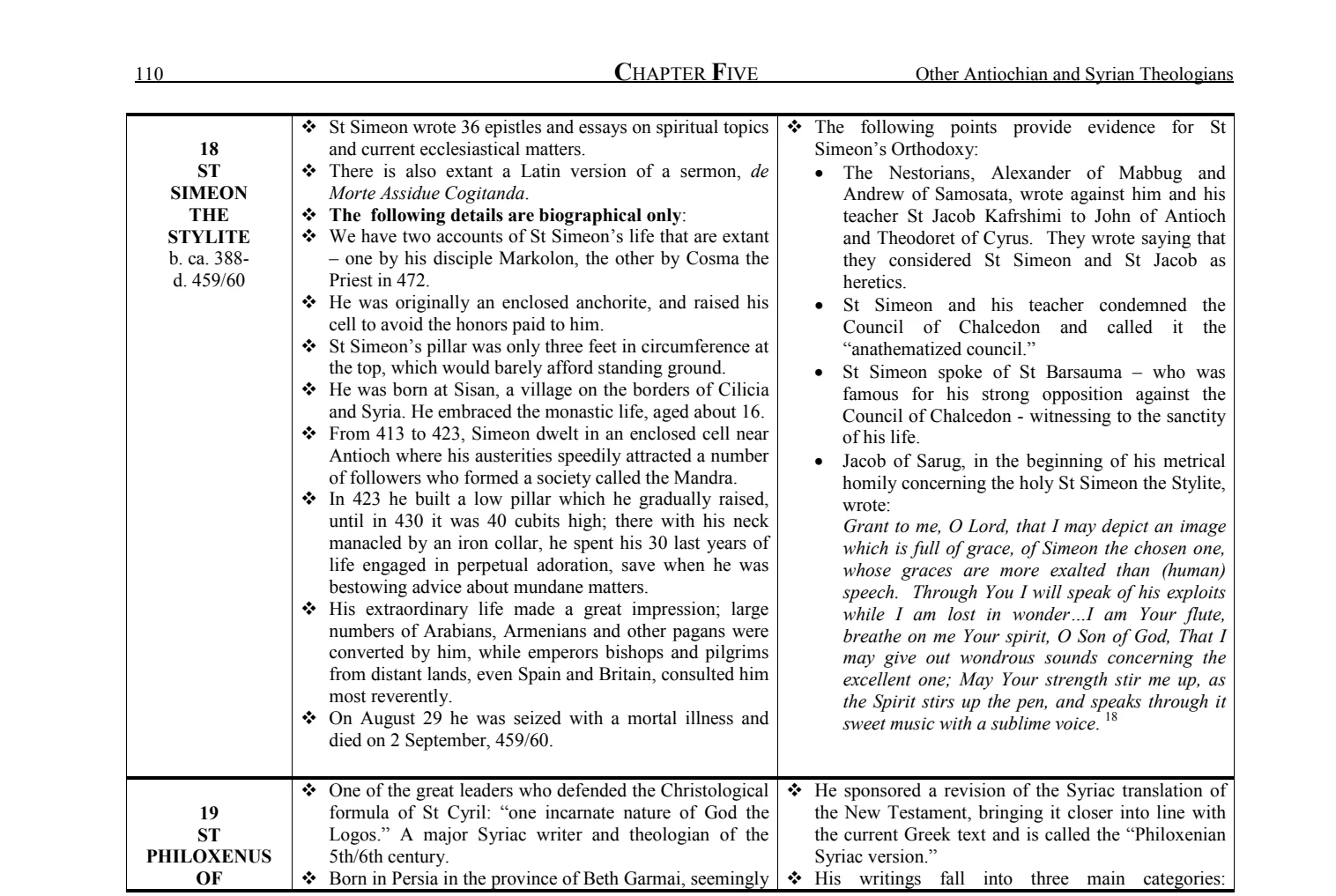
- One of the great leaders who defended the Christological formula of St Cyril: “one incarnate nature of God the Logos.” A major Syriac writer and theologian of the 5th/6th century.
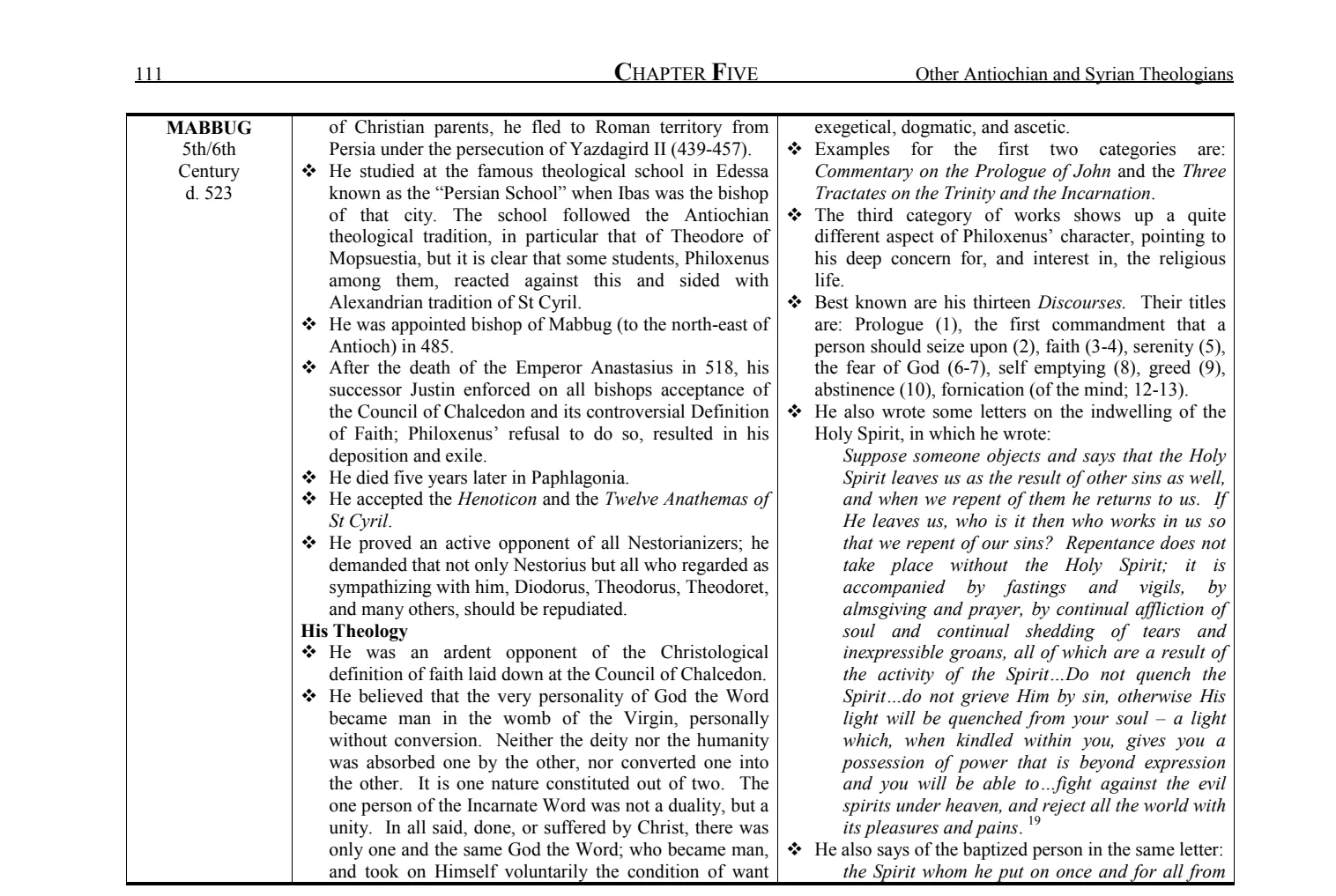
- Born in Persia in the province of Beth Garmai, seemingly of Christian parents, he fled to Roman territory from Persia under the persecution of Yazdagird II (439-457).
- He studied at the famous theological school in Edessa known as the “Persian School” when Ibas was the bishop of that city. The school followed the Antiochian theological tradition, in particular that of Theodore of Mopsuestia, but it is clear that some students, Philoxenus among them, reacted against this and sided with Alexandrian tradition of St Cyril.
- He was appointed bishop of Mabbug (to the north-east of Antioch) in 485.
- After the death of the Emperor Anastasius in 518, his successor Justin enforced on all bishops acceptance of the Council of Chalcedon and its controversial Definition of Faith; Philoxenus’ refusal to do so, resulted in his deposition and exile.
- He died five years later in Paphlagonia.
- He accepted the Henoticon and the Twelve Anathemas of St Cyril.
- He proved an active opponent of all Nestorianizers; he demanded that not only Nestorius but all who regarded as sympathizing with him, Diodorus, Theodorus, Theodoret, and many others, should be repudiated.
His Theology
- He was an ardent opponent of the Christological definition of faith laid down at the Council of Chalcedon.
- He believed that the very personality of God the Word became man in the womb of the Virgin, personally without conversion. Neither the deity nor the humanity was absorbed one by the other, nor converted one into the other. It is one nature constituted out of two. The one person of the Incarnate Word was not a duality, but a unity. In all said, done, or suffered by Christ, there was only one and the same God the Word; who became man, and took on Himself voluntarily the condition of want and suffering, for the accomplishment of man’s redemption.
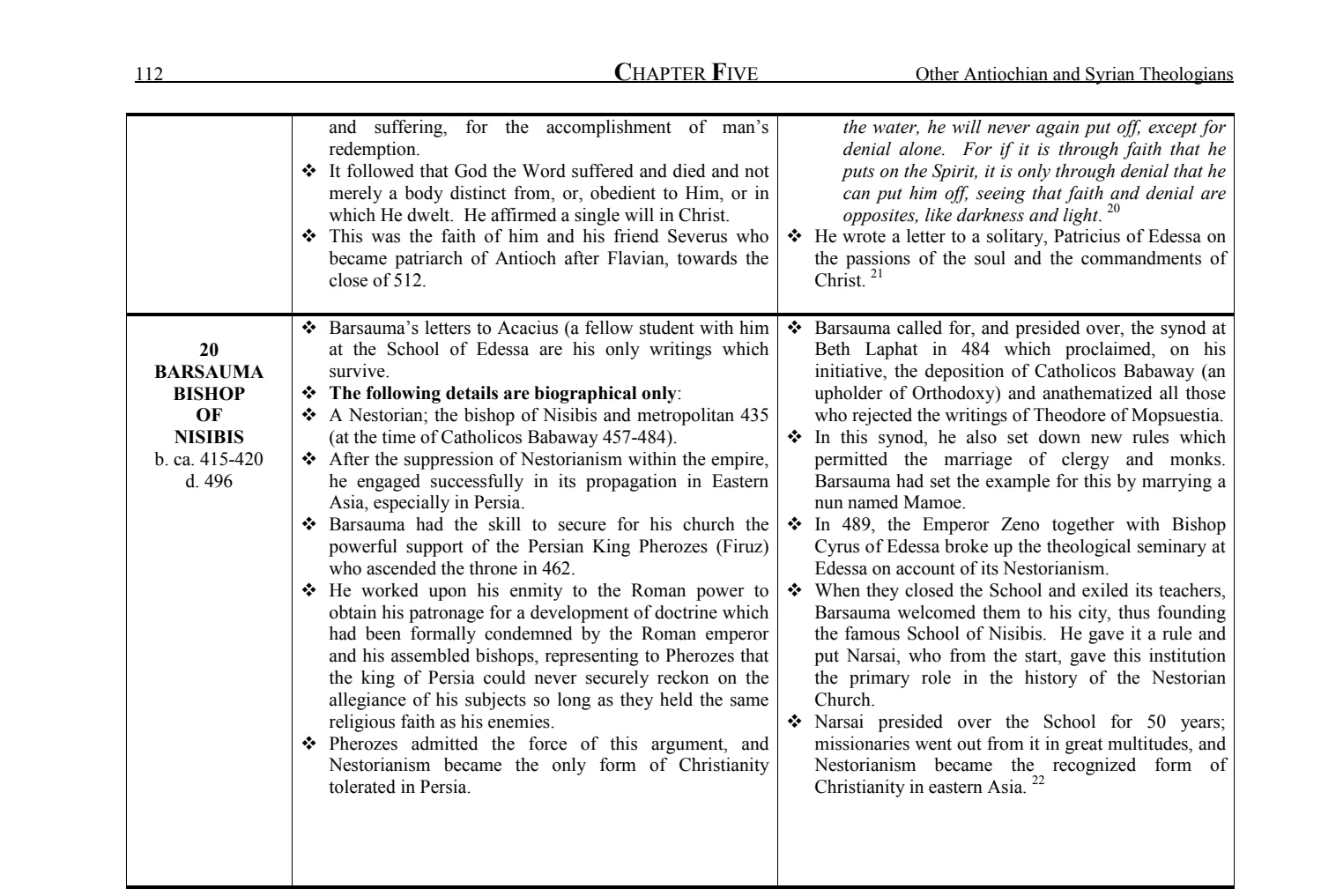
- It followed that God the Word suffered and died and not merely a body distinct from, or, obedient to Him, or in which He dwelt. He affirmed a single will in Christ.
- This was the faith of him and his friend Severus who became patriarch of Antioch after Flavian, towards the close of 512.
WRITINGS
- He sponsored a revision of the Syriac translation of the New Testament, bringing it closer into line with the current Greek text and is called the “Philoxenian Syriac version.”
- His writings fall into three main categories: exegetical, dogmatic, and ascetic.
- Examples for the first two categories are: Commentary on the Prologue of John and the Three Tractates on the Trinity and the Incarnation.
- The third category of works shows up a quite different aspect of Philoxenus’ character, pointing to his deep concern for, and interest in, the religious life.
- Best known are his thirteen Discourses. Their titles are: Prologue (1), the first commandment that a person should seize upon (2), faith (3-4), serenity (5), the fear of God (6-7), self emptying (8), greed (9), abstinence (10), fornication (of the mind; 12-13).
- He also wrote some letters on the indwelling of the Holy Spirit, in which he wrote: Suppose someone objects and says that the Holy Spirit leaves us as the result of other sins as well, and when we repent of them he returns to us. If He leaves us, who is it then who works in us so that we repent of our sins? Repentance does not take place without the Holy Spirit; it is accompanied by fastings and vigils, by almsgiving and prayer, by continual affliction of soul and continual shedding of tears and inexpressible groans, all of which are a result of the activity of the Spirit…Do not quench the Spirit…do not grieve Him by sin, otherwise His light will be quenched from your soul – a light which, when kindled within you, gives you a possession of power that is beyond expression and you will be able to…fight against the evil spirits under heaven, and reject all the world with its pleasures and pains. 19
- He also says of the baptized person in the same letter: the Spirit whom he put on once and for all from the water, he will never again put off, except for denial alone. For if it is through faith that he puts on the Spirit, it is only through denial that he can put him off, seeing that faith and denial are opposites, like darkness and light. 20
- He wrote a letter to a solitary, Patricius of Edessa on the passions of the soul and the commandments of Christ. 21
From A Panoramic View of Patristics by Hegumen Fr. Tadros Yacoub Malaty (Preparatory edition, February 2005, St George’s Coptic Orthodox Church, Sporting, Alexandria).
Chapter 5, Other Antiochian and Syrian theologians, pp. 110–112
Original book pages (3)