Church Father
From Fr. Tadros’s book
BIOGRAPHY
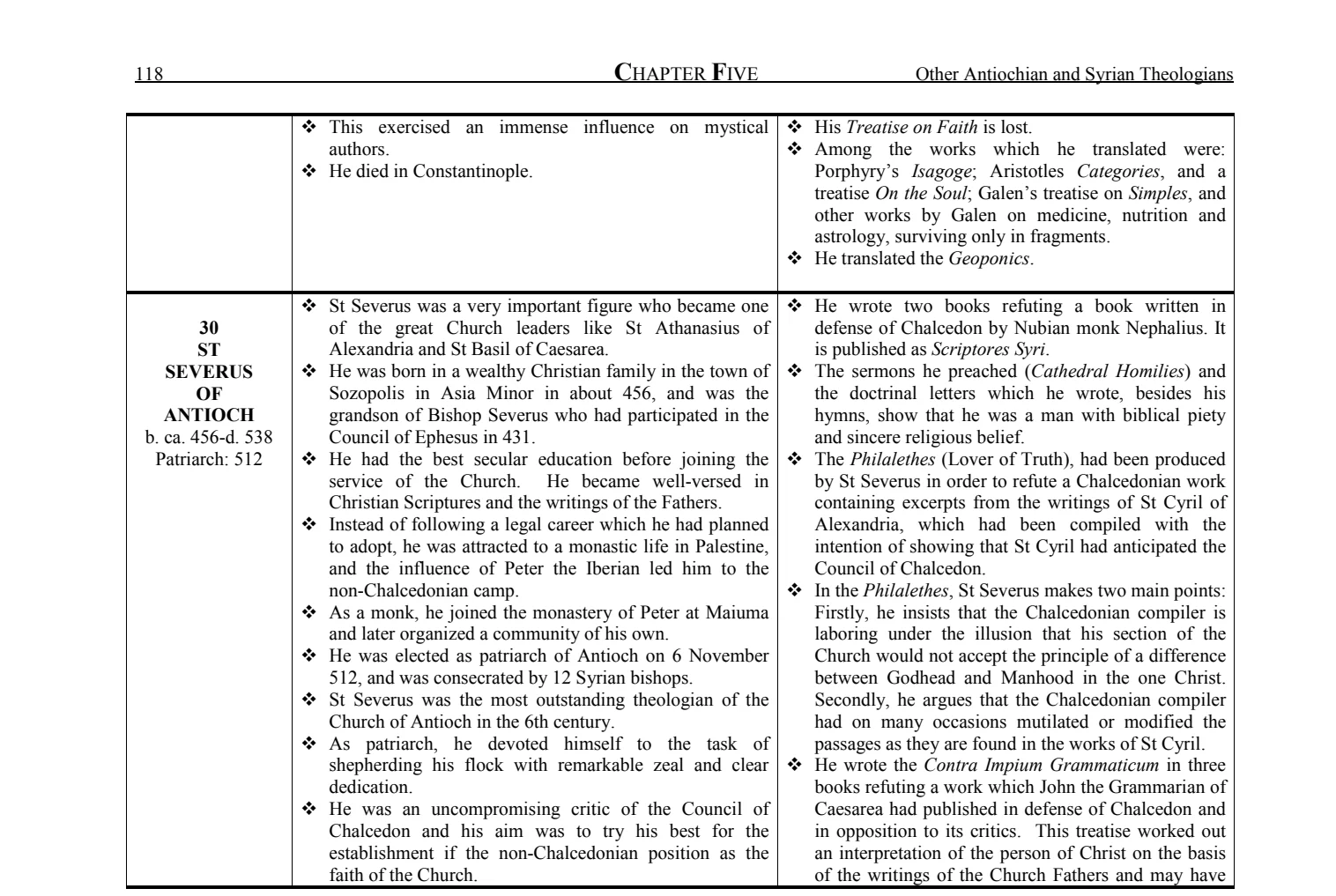
- St Severus was a very important figure who became one of the great Church leaders like St Athanasius of Alexandria and St Basil of Caesarea.
- He was born in a wealthy Christian family in the town of Sozopolis in Asia Minor in about 456, and was the grandson of Bishop Severus who had participated in the Council of Ephesus in 431.
- He had the best secular education before joining the service of the Church. He became well-versed in Christian Scriptures and the writings of the Fathers.
- Instead of following a legal career which he had planned to adopt, he was attracted to a monastic life in Palestine, and the influence of Peter the Iberian led him to the non-Chalcedonian camp.
- As a monk, he joined the monastery of Peter at Maiuma and later organized a community of his own.
- He was elected as patriarch of Antioch on 6 November 512, and was consecrated by 12 Syrian bishops.
- St Severus was the most outstanding theologian of the Church of Antioch in the 6th century.
- As patriarch, he devoted himself to the task of shepherding his flock with remarkable zeal and clear dedication.
- He was an uncompromising critic of the Council of Chalcedon and his aim was to try his best for the establishment if the non-Chalcedonian position as the faith of the Church.
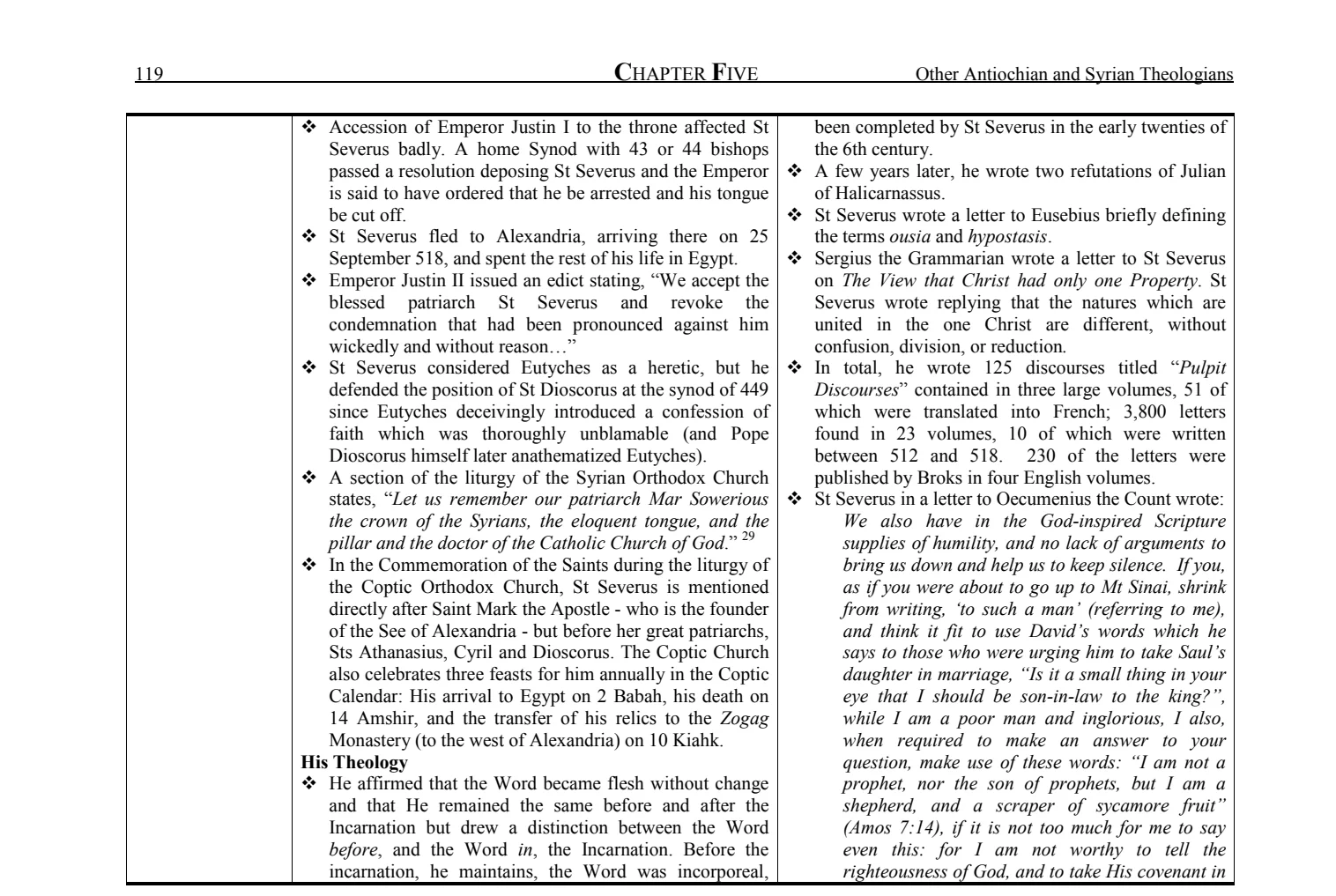
- Accession of Emperor Justin I to the throne affected St Severus badly. A home Synod with 43 or 44 bishops passed a resolution deposing St Severus and the Emperor is said to have ordered that he be arrested and his tongue be cut off.
- St Severus fled to Alexandria, arriving there on 25 September 518, and spent the rest of his life in Egypt.
- Emperor Justin II issued an edict stating, “We accept the blessed patriarch St Severus and revoke the condemnation that had been pronounced against him wickedly and without reason…”
- St Severus considered Eutyches as a heretic, but he defended the position of St Dioscorus at the synod of 449 since Eutyches deceivingly introduced a confession of faith which was thoroughly unblamable (and Pope Dioscorus himself later anathematized Eutyches).
- A section of the liturgy of the Syrian Orthodox Church states, “Let us remember our patriarch Mar Sowerious the crown of the Syrians, the eloquent tongue, and the pillar and the doctor of the Catholic Church of God.” 29
- In the Commemoration of the Saints during the liturgy of the Coptic Orthodox Church, St Severus is mentioned directly after Saint Mark the Apostle - who is the founder of the See of Alexandria - but before her great patriarchs, Sts Athanasius, Cyril and Dioscorus. The Coptic Church also celebrates three feasts for him annually in the Coptic Calendar: His arrival to Egypt on 2 Babah, his death on 14 Amshir, and the transfer of his relics to the Zogag Monastery (to the west of Alexandria) on 10 Kiahk.
His Theology
- He affirmed that the Word became flesh without change and that He remained the same before and after the Incarnation but drew a distinction between the Word before, and the Word in, the Incarnation. Before the incarnation, he maintains, the Word was incorporeal, simple, invisible and beyond all sensory perception; but in the Incarnation He is corporeal, composite and united with flesh.
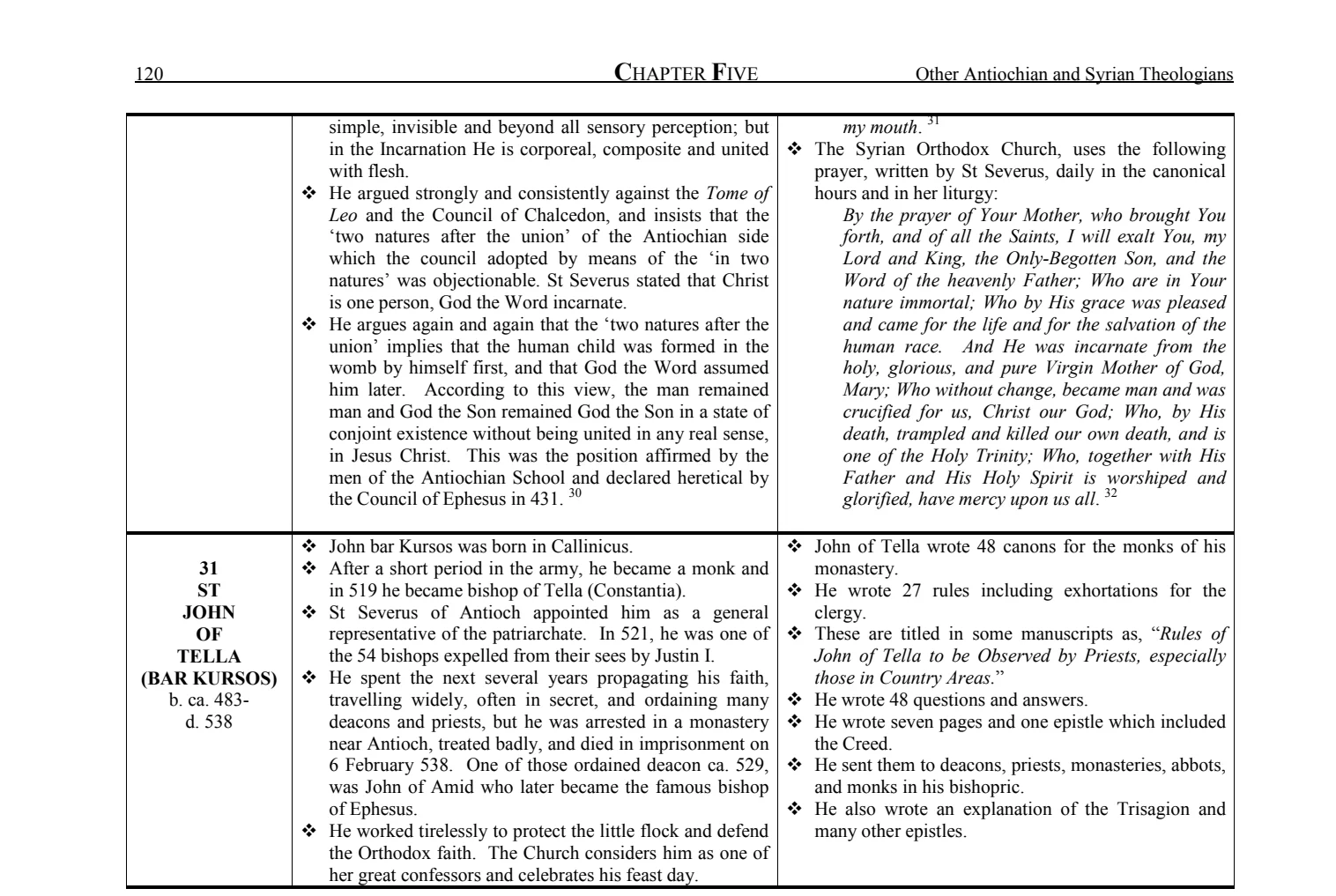
- He argued strongly and consistently against the Tome of Leo and the Council of Chalcedon, and insists that the ‘two natures after the union’ of the Antiochian side which the council adopted by means of the ‘in two natures’ was objectionable. St Severus stated that Christ is one person, God the Word incarnate.
- He argues again and again that the ‘two natures after the union’ implies that the human child was formed in the womb by himself first, and that God the Word assumed him later. According to this view, the man remained man and God the Son remained God the Son in a state of conjoint existence without being united in any real sense, in Jesus Christ. This was the position affirmed by the men of the Antiochian School and declared heretical by the Council of Ephesus in 431. 30
WRITINGS
- He wrote two books refuting a book written in defense of Chalcedon by Nubian monk Nephalius. It is published as Scriptores Syri.
- The sermons he preached (Cathedral Homilies) and the doctrinal letters which he wrote, besides his hymns, show that he was a man with biblical piety and sincere religious belief.
- The Philalethes (Lover of Truth), had been produced by St Severus in order to refute a Chalcedonian work containing excerpts from the writings of St Cyril of Alexandria, which had been compiled with the intention of showing that St Cyril had anticipated the Council of Chalcedon.
- In the Philalethes, St Severus makes two main points: Firstly, he insists that the Chalcedonian compiler is laboring under the illusion that his section of the Church would not accept the principle of a difference between Godhead and Manhood in the one Christ. Secondly, he argues that the Chalcedonian compiler had on many occasions mutilated or modified the passages as they are found in the works of St Cyril.
- He wrote the Contra Impium Grammaticum in three books refuting a work which John the Grammarian of Caesarea had published in defense of Chalcedon and in opposition to its critics. This treatise worked out an interpretation of the person of Christ on the basis of the writings of the Church Fathers and may have been completed by St Severus in the early twenties of the 6th century.
- A few years later, he wrote two refutations of Julian of Halicarnassus.
- St Severus wrote a letter to Eusebius briefly defining the terms ousia and hypostasis.
- Sergius the Grammarian wrote a letter to St Severus on The View that Christ had only one Property. St Severus wrote replying that the natures which are united in the one Christ are different, without confusion, division, or reduction.
- In total, he wrote 125 discourses titled “Pulpit Discourses” contained in three large volumes, 51 of which were translated into French; 3,800 letters found in 23 volumes, 10 of which were written between 512 and 518. 230 of the letters were published by Broks in four English volumes.
- St Severus in a letter to Oecumenius the Count wrote: We also have in the God-inspired Scripture supplies of humility, and no lack of arguments to bring us down and help us to keep silence. If you, as if you were about to go up to Mt Sinai, shrink from writing, ‘to such a man’ (referring to me), and think it fit to use David’s words which he says to those who were urging him to take Saul’s daughter in marriage, “Is it a small thing in your eye that I should be son-in-law to the king?”, while I am a poor man and inglorious, I also, when required to make an answer to your question, make use of these words: “I am not a prophet, nor the son of prophets, but I am a shepherd, and a scraper of sycamore fruit” (Amos 7:14), if it is not too much for me to say even this: for I am not worthy to tell the righteousness of God, and to take His covenant in my mouth. 31
- The Syrian Orthodox Church, uses the following prayer, written by St Severus, daily in the canonical hours and in her liturgy: By the prayer of Your Mother, who brought You forth, and of all the Saints, I will exalt You, my Lord and King, the Only-Begotten Son, and the Word of the heavenly Father; Who are in Your nature immortal; Who by His grace was pleased and came for the life and for the salvation of the human race. And He was incarnate from the holy, glorious, and pure Virgin Mother of God, Mary; Who without change, became man and was crucified for us, Christ our God; Who, by His death, trampled and killed our own death, and is one of the Holy Trinity; Who, together with His Father and His Holy Spirit is worshiped and glorified, have mercy upon us all. 32
From A Panoramic View of Patristics by Hegumen Fr. Tadros Yacoub Malaty (Preparatory edition, February 2005, St George’s Coptic Orthodox Church, Sporting, Alexandria).
Chapter 5, Other Antiochian and Syrian theologians, pp. 118–120
Original book pages (3)