Church Father
From Fr. Tadros’s book
BIOGRAPHY
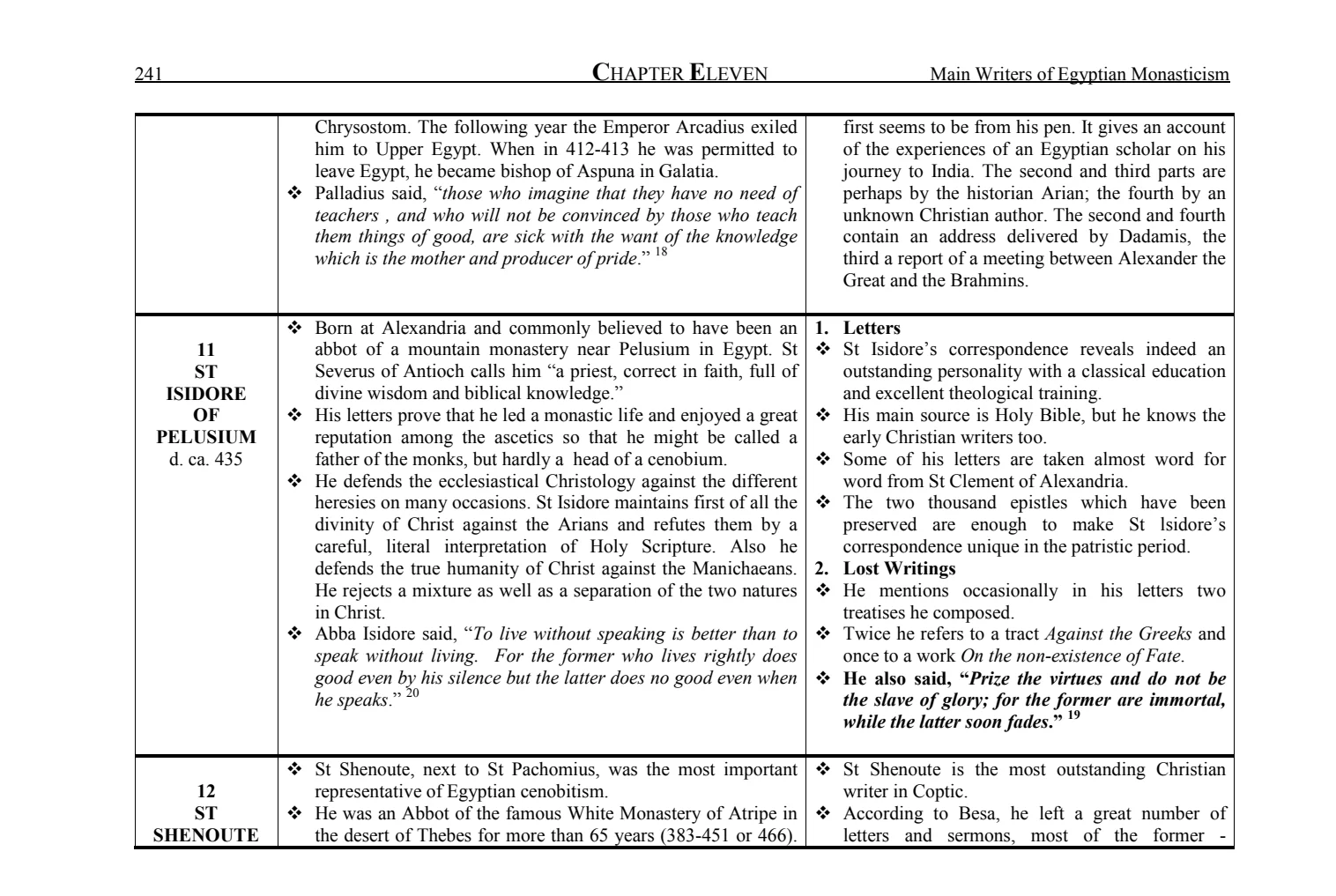
- St Shenoute, next to St Pachomius, was the most important representative of Egyptian cenobitism.
- He was an Abbot of the famous White Monastery of Atripe in the desert of Thebes for more than 65 years (383-451 or 466).
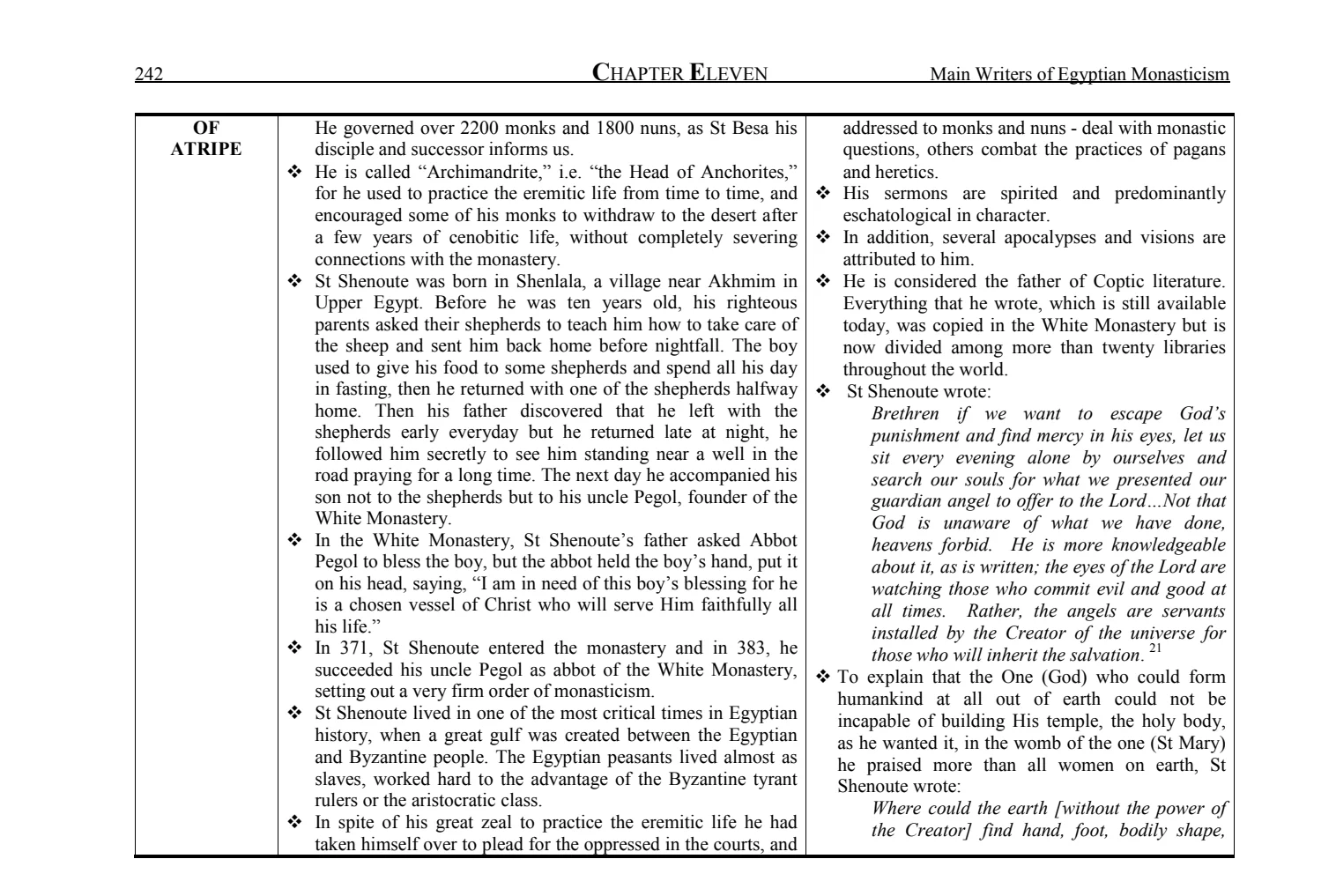
He governed over 2200 monks and 1800 nuns, as St Besa his disciple and successor informs us.
- He is called “Archimandrite,” i.e. “the Head of Anchorites,” for he used to practice the eremitic life from time to time, and encouraged some of his monks to withdraw to the desert after a few years of cenobitic life, without completely severing connections with the monastery.
- St Shenoute was born in Shenlala, a village near Akhmim in Upper Egypt. Before he was ten years old, his righteous parents asked their shepherds to teach him how to take care of the sheep and sent him back home before nightfall. The boy used to give his food to some shepherds and spend all his day in fasting, then he returned with one of the shepherds halfway home. Then his father discovered that he left with the shepherds early everyday but he returned late at night, he followed him secretly to see him standing near a well in the road praying for a long time. The next day he accompanied his son not to the shepherds but to his uncle Pegol, founder of the White Monastery.
- In the White Monastery, St Shenoute’s father asked Abbot Pegol to bless the boy, but the abbot held the boy’s hand, put it on his head, saying, “I am in need of this boy’s blessing for he is a chosen vessel of Christ who will serve Him faithfully all his life.”
- In 371, St Shenoute entered the monastery and in 383, he succeeded his uncle Pegol as abbot of the White Monastery, setting out a very firm order of monasticism.
- St Shenoute lived in one of the most critical times in Egyptian history, when a great gulf was created between the Egyptian and Byzantine people. The Egyptian peasants lived almost as slaves, worked hard to the advantage of the Byzantine tyrant rulers or the aristocratic class.
- In spite of his great zeal to practice the eremitic life he had taken himself over to plead for the oppressed in the courts, and if he failed he would write to the emperor himself.
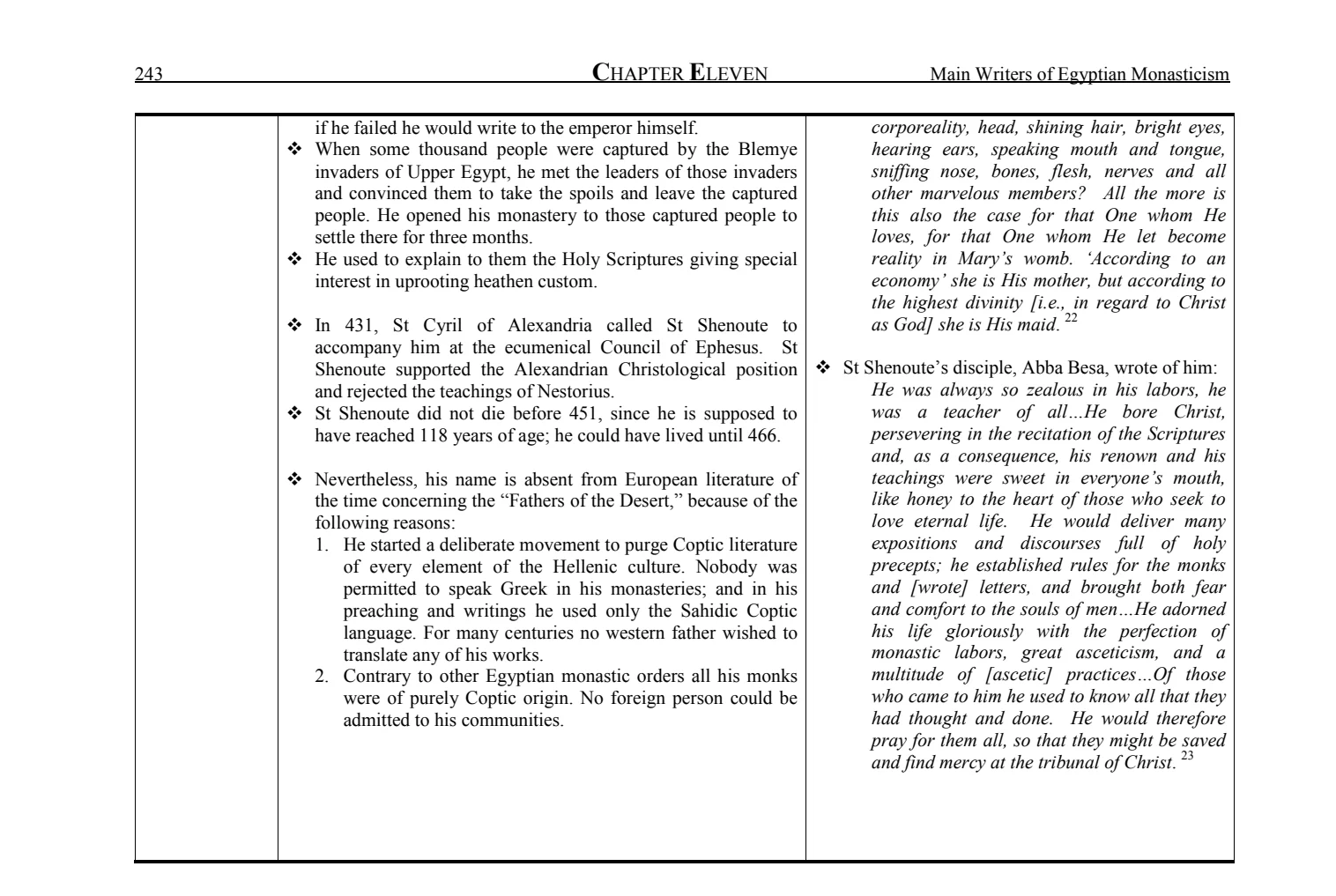
- When some thousand people were captured by the Blemye invaders of Upper Egypt, he met the leaders of those invaders and convinced them to take the spoils and leave the captured people. He opened his monastery to those captured people to settle there for three months.
- He used to explain to them the Holy Scriptures giving special interest in uprooting heathen custom.
- In 431, St Cyril of Alexandria called St Shenoute to accompany him at the ecumenical Council of Ephesus. St Shenoute supported the Alexandrian Christological position and rejected the teachings of Nestorius.
- St Shenoute did not die before 451, since he is supposed to have reached 118 years of age; he could have lived until 466.
- Nevertheless, his name is absent from European literature of the time concerning the “Fathers of the Desert,” because of the following reasons:
1. He started a deliberate movement to purge Coptic literature of every element of the Hellenic culture. Nobody was permitted to speak Greek in his monasteries; and in his preaching and writings he used only the Sahidic Coptic language. For many centuries no western father wished to translate any of his works.
2. Contrary to other Egyptian monastic orders all his monks were of purely Coptic origin. No foreign person could be admitted to his communities.
WRITINGS AND THOUGHTS
- St Shenoute is the most outstanding Christian writer in Coptic.
- According to Besa, he left a great number of letters and sermons, most of the former - addressed to monks and nuns - deal with monastic questions, others combat the practices of pagans and heretics.
- His sermons are spirited and predominantly eschatological in character.
- In addition, several apocalypses and visions are attributed to him.
- He is considered the father of Coptic literature. Everything that he wrote, which is still available today, was copied in the White Monastery but is now divided among more than twenty libraries throughout the world.
- St Shenoute wrote: Brethren if we want to escape God’s punishment and find mercy in his eyes, let us sit every evening alone by ourselves and search our souls for what we presented our guardian angel to offer to the Lord…Not that God is unaware of what we have done, heavens forbid. He is more knowledgeable about it, as is written; the eyes of the Lord are watching those who commit evil and good at all times. Rather, the angels are servants installed by the Creator of the universe for those who will inherit the salvation. 21
- To explain that the One (God) who could form humankind at all out of earth could not be incapable of building His temple, the holy body, as he wanted it, in the womb of the one (St Mary) he praised more than all women on earth, St Shenoute wrote: Where could the earth [without the power of the Creator] find hand, foot, bodily shape, corporeality, head, shining hair, bright eyes, hearing ears, speaking mouth and tongue, sniffing nose, bones, flesh, nerves and all other marvelous members? All the more is this also the case for that One whom He loves, for that One whom He let become reality in Mary’s womb. ‘According to an economy’ she is His mother, but according to the highest divinity [i.e., in regard to Christ as God] she is His maid. 22
- St Shenoute’s disciple, Abba Besa, wrote of him: He was always so zealous in his labors, he was a teacher of all…He bore Christ, persevering in the recitation of the Scriptures and, as a consequence, his renown and his teachings were sweet in everyone’s mouth, like honey to the heart of those who seek to love eternal life. He would deliver many expositions and discourses full of holy precepts; he established rules for the monks and [wrote] letters, and brought both fear and comfort to the souls of men…He adorned his life gloriously with the perfection of monastic labors, great asceticism, and a multitude of [ascetic] practices…Of those who came to him he used to know all that they had thought and done. He would therefore pray for them all, so that they might be saved and find mercy at the tribunal of Christ. 23
From A Panoramic View of Patristics by Hegumen Fr. Tadros Yacoub Malaty (Preparatory edition, February 2005, St George’s Coptic Orthodox Church, Sporting, Alexandria).
Chapter 11, Egyptian monasticism, pp. 241–244
Original book pages (3)