Writer & teacher
From Fr. Tadros’s book
Printed p. 17
ABOUT HIS WRITINGS
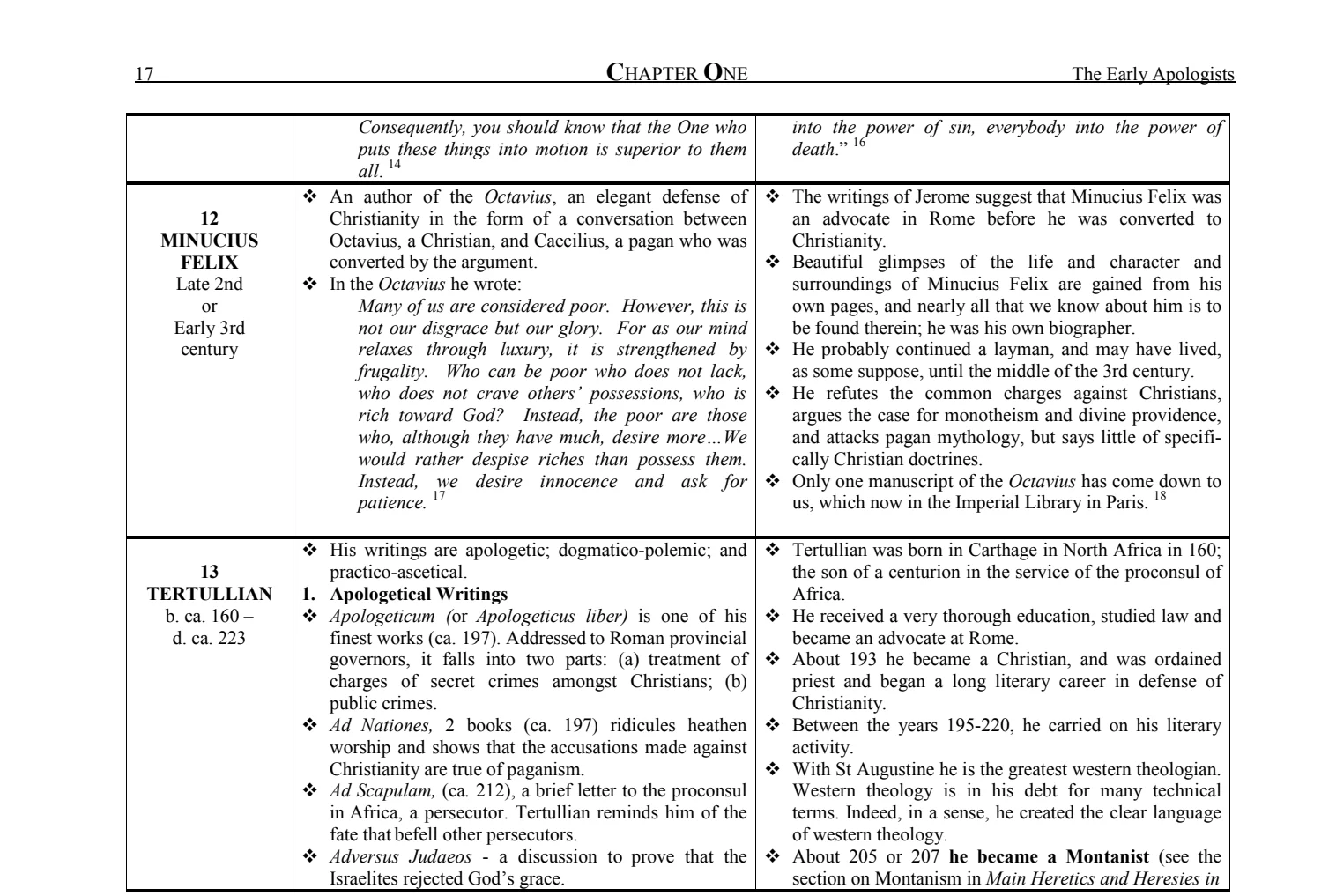
- His writings are apologetic; dogmatico-polemic; and practico-ascetical.
1. Apologetical Writings
- Apologeticum (or Apologeticus liber) is one of his finest works (ca. 197). Addressed to Roman provincial governors, it falls into two parts: (a) treatment of charges of secret crimes amongst Christians; (b) public crimes.
- Ad Nationes, 2 books (ca. 197) ridicules heathen worship and shows that the accusations made against Christianity are true of paganism.
- Ad Scapulam, (ca. 212), a brief letter to the proconsul in Africa, a persecutor. Tertullian reminds him of the fate that befell other persecutors.
- Adversus Judaeos - a discussion to prove that the Israelites rejected God’s grace.
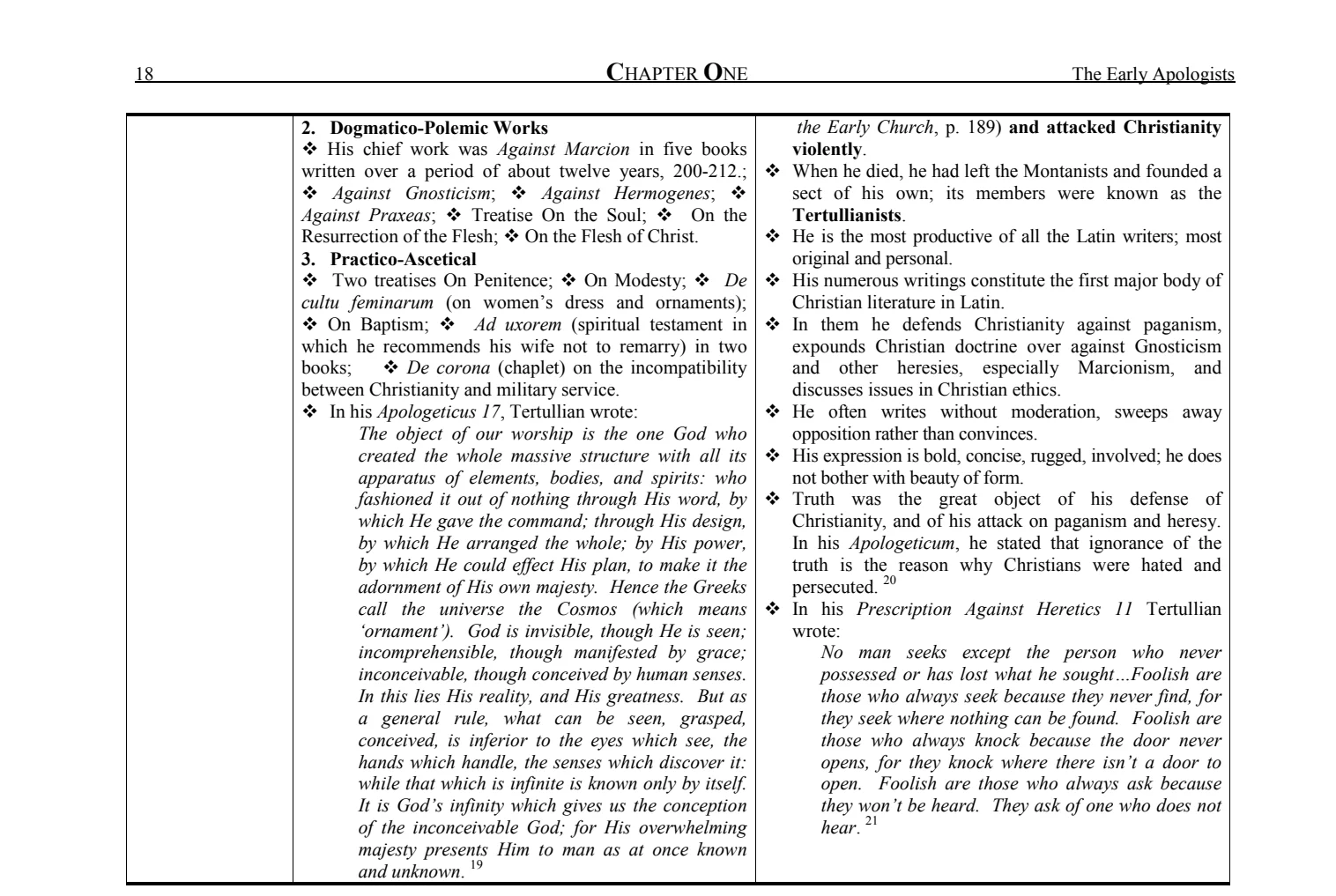
2. Dogmatico-Polemic Works
- His chief work was Against Marcion in five books written over a period of about twelve years, 200-212.;
- Against Gnosticism; • Against Hermogenes; • Against Praxeas; • Treatise On the Soul; • On the Resurrection of the Flesh; • On the Flesh of Christ.
3. Practico-Ascetical
- Two treatises On Penitence; • On Modesty; • De cultu feminarum (on women’s dress and ornaments);
- On Baptism; • Ad uxorem (spiritual testament in which he recommends his wife not to remarry) in two books; • De corona (chaplet) on the incompatibility between Christianity and military service.
- In his Apologeticus 17, Tertullian wrote: The object of our worship is the one God who created the whole massive structure with all its apparatus of elements, bodies, and spirits: who fashioned it out of nothing through His word, by which He gave the command; through His design, by which He arranged the whole; by His power, by which He could effect His plan, to make it the adornment of His own majesty. Hence the Greeks call the universe the Cosmos (which means ‘ornament’). God is invisible, though He is seen; incomprehensible, though manifested by grace; inconceivable, though conceived by human senses. In this lies His reality, and His greatness. But as a general rule, what can be seen, grasped, conceived, is inferior to the eyes which see, the hands which handle, the senses which discover it: while that which is infinite is known only by itself. It is God’s infinity which gives us the conception of the inconceivable God; for His overwhelming majesty presents Him to man as at once known and unknown. 19
REMARKS
- Tertullian was born in Carthage in North Africa in 160; the son of a centurion in the service of the proconsul of Africa.
- He received a very thorough education, studied law and became an advocate at Rome.
- About 193 he became a Christian, and was ordained priest and began a long literary career in defense of Christianity.
- Between the years 195-220, he carried on his literary activity.
- With St Augustine he is the greatest western theologian. Western theology is in his debt for many technical terms. Indeed, in a sense, he created the clear language of western theology.
- About 205 or 207 he became a Montanist (see the section on Montanism in Main Heretics and Heresies in the Early Church, p. 189) and attacked Christianity violently.
- When he died, he had left the Montanists and founded a sect of his own; its members were known as the Tertullianists.
- He is the most productive of all the Latin writers; most original and personal.
- His numerous writings constitute the first major body of Christian literature in Latin.
- In them he defends Christianity against paganism, expounds Christian doctrine over against Gnosticism and other heresies, especially Marcionism, and discusses issues in Christian ethics.
- He often writes without moderation, sweeps away opposition rather than convinces.
- His expression is bold, concise, rugged, involved; he does not bother with beauty of form.
- Truth was the great object of his defense of Christianity, and of his attack on paganism and heresy. In his Apologeticum, he stated that ignorance of the truth is the reason why Christians were hated and persecuted. 20
- In his Prescription Against Heretics 11 Tertullian wrote: No man seeks except the person who never possessed or has lost what he sought…Foolish are those who always seek because they never find, for they seek where nothing can be found. Foolish are those who always knock because the door never opens, for they knock where there isn’t a door to open. Foolish are those who always ask because they won’t be heard. They ask of one who does not hear. 21
Printed p. 141
BIOGRAPHY
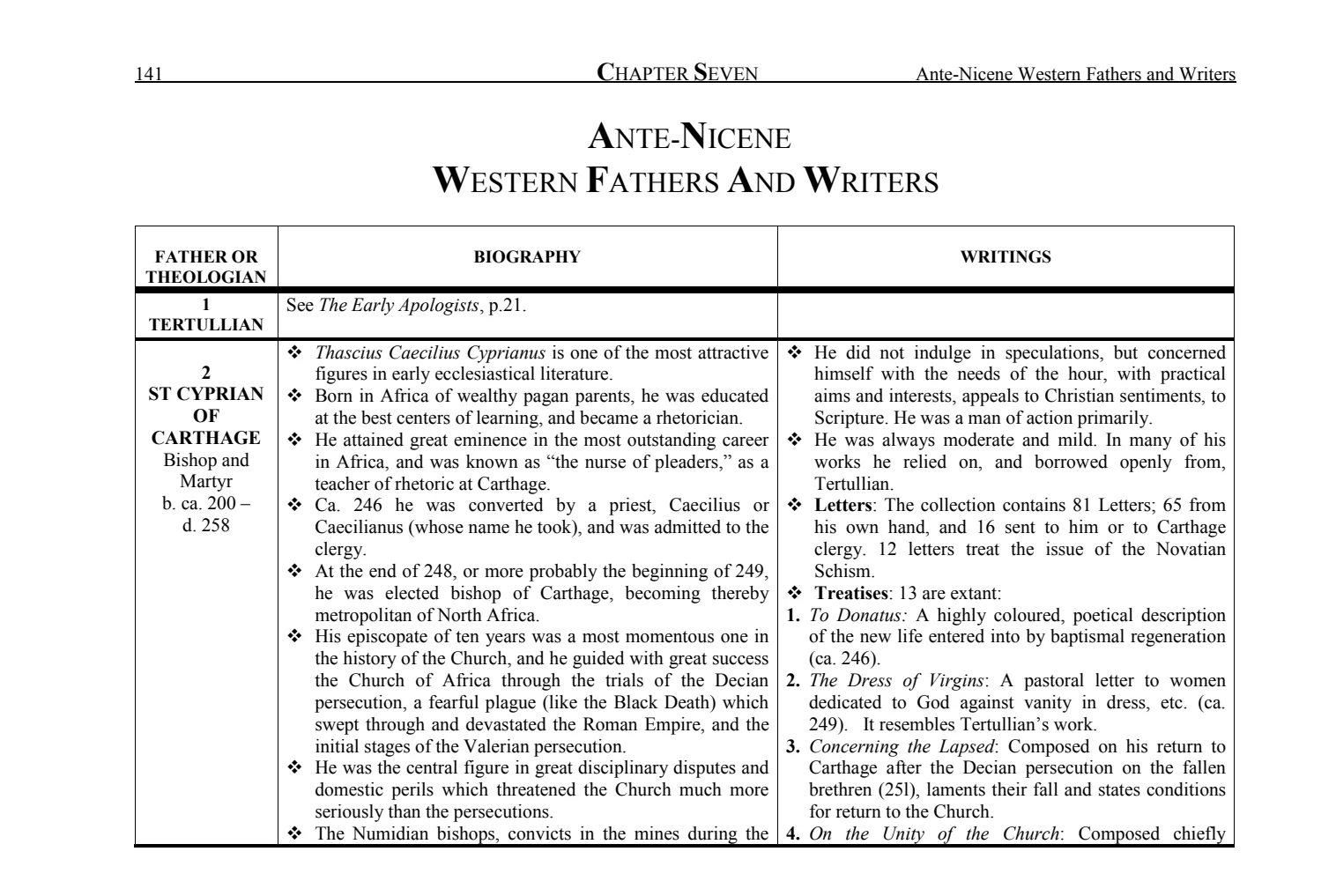
See The Early Apologists, p.21.
From A Panoramic View of Patristics by Hegumen Fr. Tadros Yacoub Malaty (Preparatory edition, February 2005, St George’s Coptic Orthodox Church, Sporting, Alexandria).
Chapter 1, Early apologists, pp. 17–19
Chapter 7, Ante-Nicene Western writers, pp. 141–143
Original book pages (3)