Church Father
From Fr. Tadros’s book
BIOGRAPHY
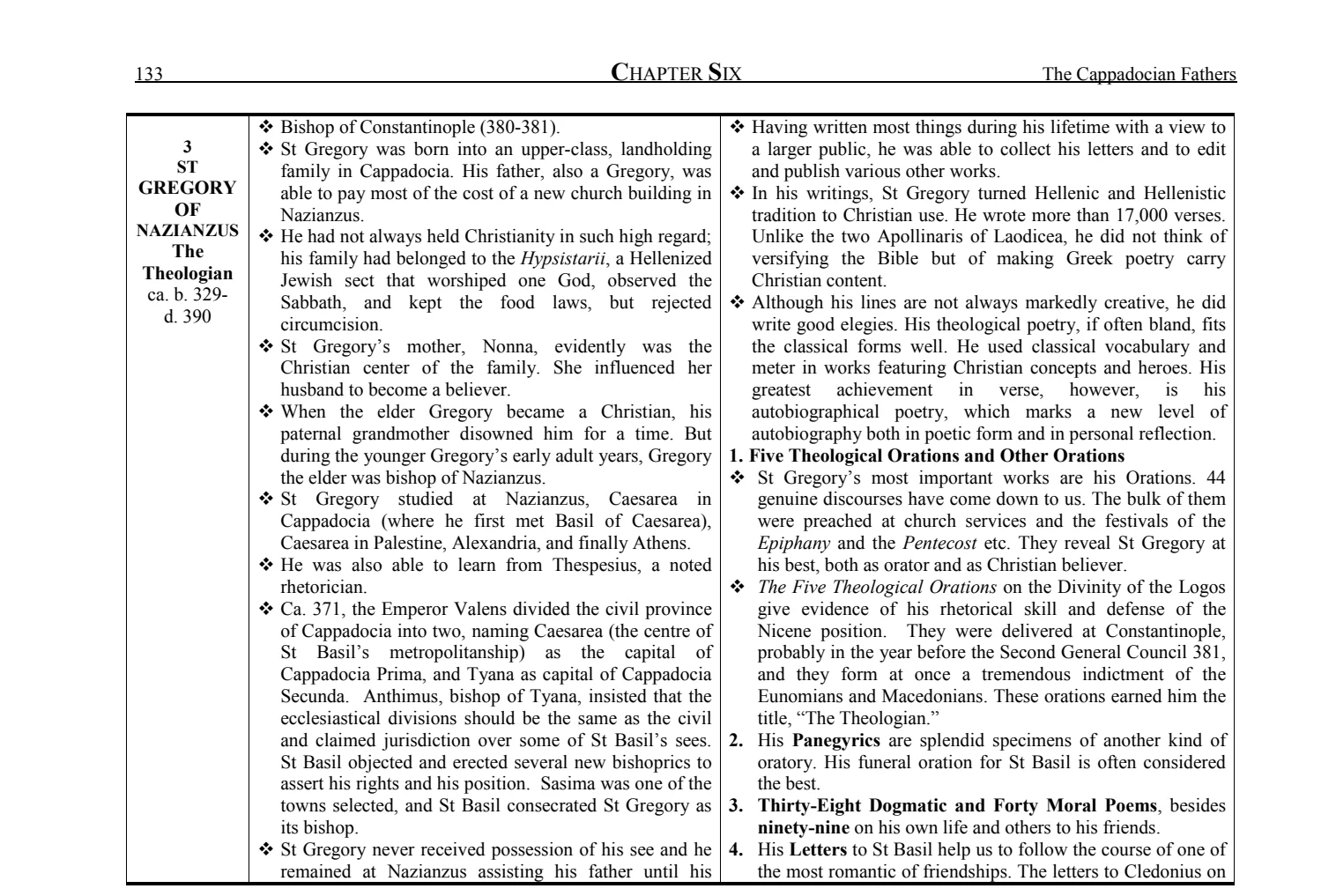
- Bishop of Constantinople (380-381).
- St Gregory was born into an upper-class, landholding family in Cappadocia. His father, also a Gregory, was able to pay most of the cost of a new church building in Nazianzus.
- He had not always held Christianity in such high regard; his family had belonged to the Hypsistarii, a Hellenized Jewish sect that worshiped one God, observed the Sabbath, and kept the food laws, but rejected circumcision.
- St Gregory’s mother, Nonna, evidently was the Christian center of the family. She influenced her husband to become a believer.
- When the elder Gregory became a Christian, his paternal grandmother disowned him for a time. But during the younger Gregory’s early adult years, Gregory the elder was bishop of Nazianzus.
- St Gregory studied at Nazianzus, Caesarea in Cappadocia (where he first met Basil of Caesarea), Caesarea in Palestine, Alexandria, and finally Athens.
- He was also able to learn from Thespesius, a noted rhetorician.
- Ca. 371, the Emperor Valens divided the civil province of Cappadocia into two, naming Caesarea (the centre of St Basil’s metropolitanship) as the capital of Cappadocia Prima, and Tyana as capital of Cappadocia Secunda. Anthimus, bishop of Tyana, insisted that the ecclesiastical divisions should be the same as the civil and claimed jurisdiction over some of St Basil’s sees. St Basil objected and erected several new bishoprics to assert his rights and his position. Sasima was one of the towns selected, and St Basil consecrated St Gregory as its bishop.
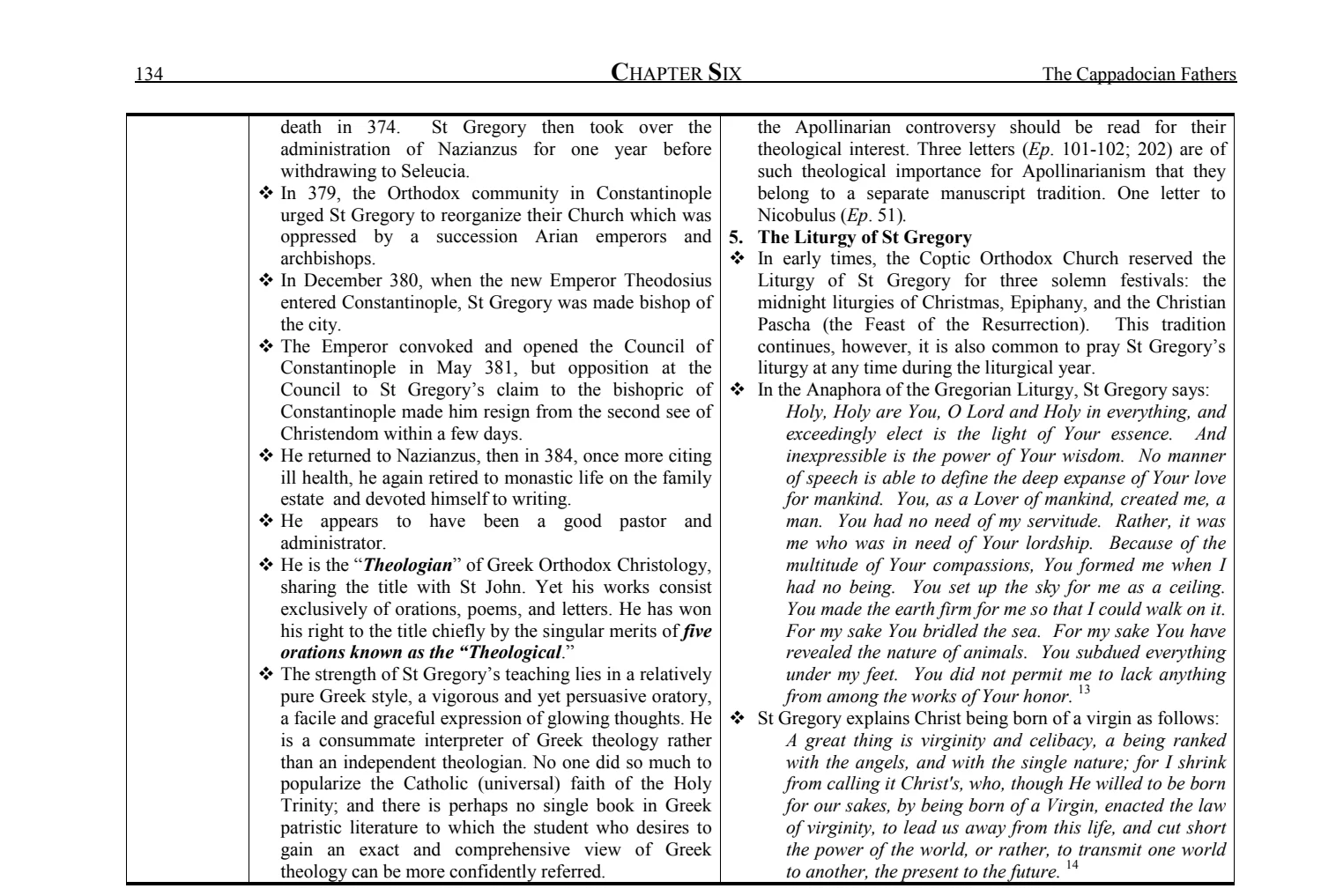
- St Gregory never received possession of his see and he remained at Nazianzus assisting his father until his death in 374. St Gregory then took over the administration of Nazianzus for one year before withdrawing to Seleucia.
- In 379, the Orthodox community in Constantinople urged St Gregory to reorganize their Church which was oppressed by a succession Arian emperors and archbishops.
- In December 380, when the new Emperor Theodosius entered Constantinople, St Gregory was made bishop of the city.
- The Emperor convoked and opened the Council of Constantinople in May 381, but opposition at the Council to St Gregory’s claim to the bishopric of Constantinople made him resign from the second see of Christendom within a few days.
- He returned to Nazianzus, then in 384, once more citing ill health, he again retired to monastic life on the family estate and devoted himself to writing.
- He appears to have been a good pastor and administrator.
- He is the “Theologian” of Greek Orthodox Christology, sharing the title with St John. Yet his works consist exclusively of orations, poems, and letters. He has won his right to the title chiefly by the singular merits of five orations known as the “Theological.”
- The strength of St Gregory’s teaching lies in a relatively pure Greek style, a vigorous and yet persuasive oratory, a facile and graceful expression of glowing thoughts. He is a consummate interpreter of Greek theology rather than an independent theologian. No one did so much to popularize the Catholic (universal) faith of the Holy Trinity; and there is perhaps no single book in Greek patristic literature to which the student who desires to gain an exact and comprehensive view of Greek theology can be more confidently referred.
WRITINGS
- Having written most things during his lifetime with a view to a larger public, he was able to collect his letters and to edit and publish various other works.
- In his writings, St Gregory turned Hellenic and Hellenistic tradition to Christian use. He wrote more than 17,000 verses. Unlike the two Apollinaris of Laodicea, he did not think of versifying the Bible but of making Greek poetry carry Christian content.
- Although his lines are not always markedly creative, he did write good elegies. His theological poetry, if often bland, fits the classical forms well. He used classical vocabulary and meter in works featuring Christian concepts and heroes. His greatest achievement in verse, however, is his autobiographical poetry, which marks a new level of autobiography both in poetic form and in personal reflection.
1. Five Theological Orations and Other Orations
- St Gregory’s most important works are his Orations. 44 genuine discourses have come down to us. The bulk of them were preached at church services and the festivals of the Epiphany and the Pentecost etc. They reveal St Gregory at his best, both as orator and as Christian believer.
- The Five Theological Orations on the Divinity of the Logos give evidence of his rhetorical skill and defense of the Nicene position. They were delivered at Constantinople, probably in the year before the Second General Council 381, and they form at once a tremendous indictment of the Eunomians and Macedonians. These orations earned him the title, “The Theologian.”
2. His Panegyrics are splendid specimens of another kind of oratory. His funeral oration for St Basil is often considered the best.
3. Thirty-Eight Dogmatic and Forty Moral Poems, besides
ninety-nine on his own life and others to his friends.
4. His Letters to St Basil help us to follow the course of one of the most romantic of friendships. The letters to Cledonius on the Apollinarian controversy should be read for their theological interest. Three letters (Ep. 101-102; 202) are of such theological importance for Apollinarianism that they belong to a separate manuscript tradition. One letter to Nicobulus (Ep. 51).
5. The Liturgy of St Gregory
- In early times, the Coptic Orthodox Church reserved the Liturgy of St Gregory for three solemn festivals: the midnight liturgies of Christmas, Epiphany, and the Christian Pascha (the Feast of the Resurrection). This tradition continues, however, it is also common to pray St Gregory’s liturgy at any time during the liturgical year.
- In the Anaphora of the Gregorian Liturgy, St Gregory says: Holy, Holy are You, O Lord and Holy in everything, and exceedingly elect is the light of Your essence. And inexpressible is the power of Your wisdom. No manner of speech is able to define the deep expanse of Your love for mankind. You, as a Lover of mankind, created me, a man. You had no need of my servitude. Rather, it was me who was in need of Your lordship. Because of the multitude of Your compassions, You formed me when I had no being. You set up the sky for me as a ceiling. You made the earth firm for me so that I could walk on it. For my sake You bridled the sea. For my sake You have revealed the nature of animals. You subdued everything under my feet. You did not permit me to lack anything from among the works of Your honor. 13
- St Gregory explains Christ being born of a virgin as follows: A great thing is virginity and celibacy, a being ranked with the angels, and with the single nature; for I shrink from calling it Christ's, who, though He willed to be born for our sakes, by being born of a Virgin, enacted the law of virginity, to lead us away from this life, and cut short the power of the world, or rather, to transmit one world to another, the present to the future. 14
From A Panoramic View of Patristics by Hegumen Fr. Tadros Yacoub Malaty (Preparatory edition, February 2005, St George’s Coptic Orthodox Church, Sporting, Alexandria).
Chapter 6, Cappadocian Fathers, pp. 133–135