Church Father
From Fr. Tadros’s book
BIOGRAPHY
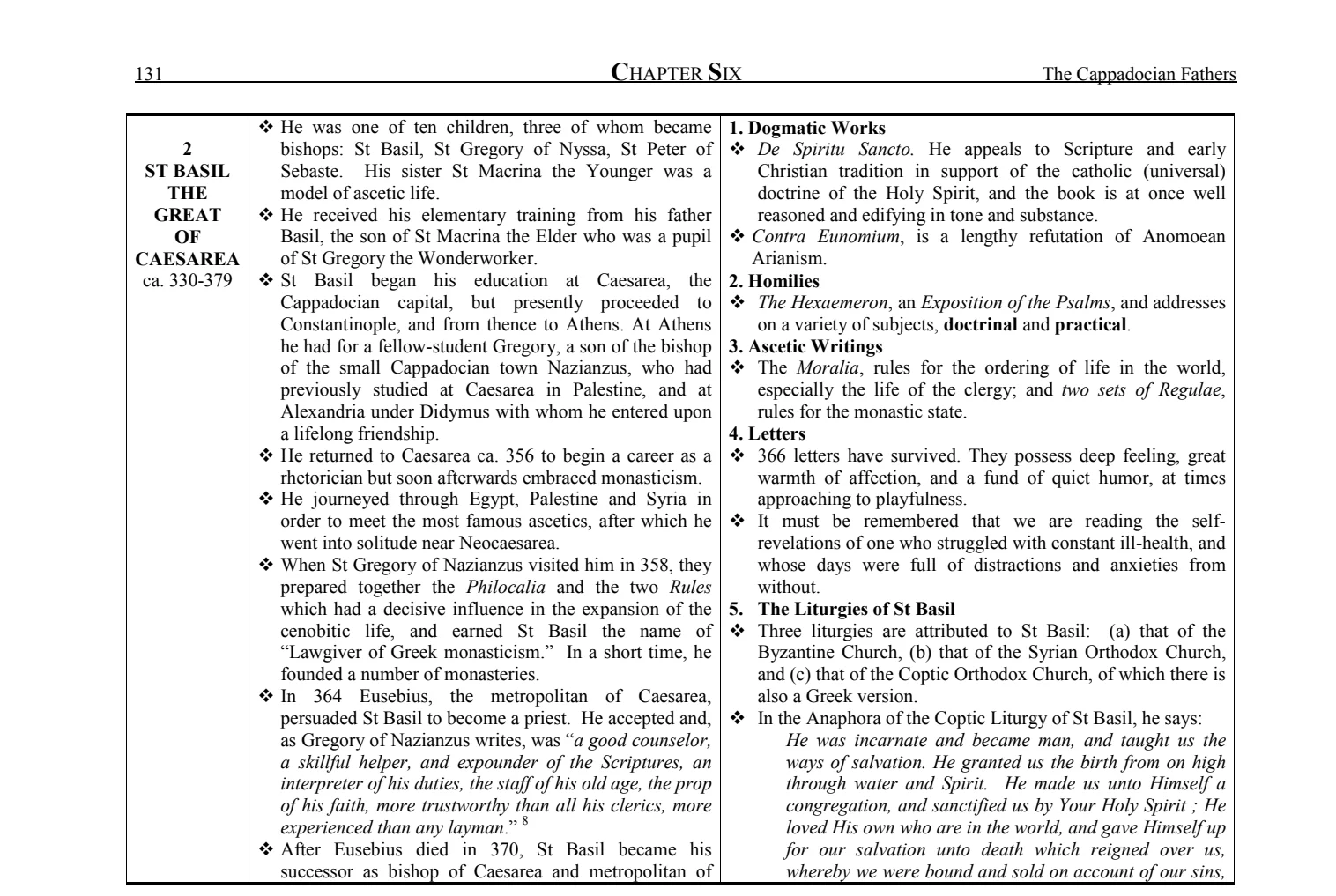
- He was one of ten children, three of whom became bishops: St Basil, St Gregory of Nyssa, St Peter of Sebaste. His sister St Macrina the Younger was a model of ascetic life.
- He received his elementary training from his father Basil, the son of St Macrina the Elder who was a pupil of St Gregory the Wonderworker.
- St Basil began his education at Caesarea, the Cappadocian capital, but presently proceeded to Constantinople, and from thence to Athens. At Athens he had for a fellow-student Gregory, a son of the bishop of the small Cappadocian town Nazianzus, who had previously studied at Caesarea in Palestine, and at Alexandria under Didymus with whom he entered upon a lifelong friendship.
- He returned to Caesarea ca. 356 to begin a career as a rhetorician but soon afterwards embraced monasticism.
- He journeyed through Egypt, Palestine and Syria in order to meet the most famous ascetics, after which he went into solitude near Neocaesarea.
- When St Gregory of Nazianzus visited him in 358, they prepared together the Philocalia and the two Rules which had a decisive influence in the expansion of the cenobitic life, and earned St Basil the name of “Lawgiver of Greek monasticism.” In a short time, he founded a number of monasteries.
- In 364 Eusebius, the metropolitan of Caesarea, persuaded St Basil to become a priest. He accepted and, as Gregory of Nazianzus writes, was “a good counselor, a skillful helper, and expounder of the Scriptures, an interpreter of his duties, the staff of his old age, the prop of his faith, more trustworthy than all his clerics, more experienced than any layman.” 8
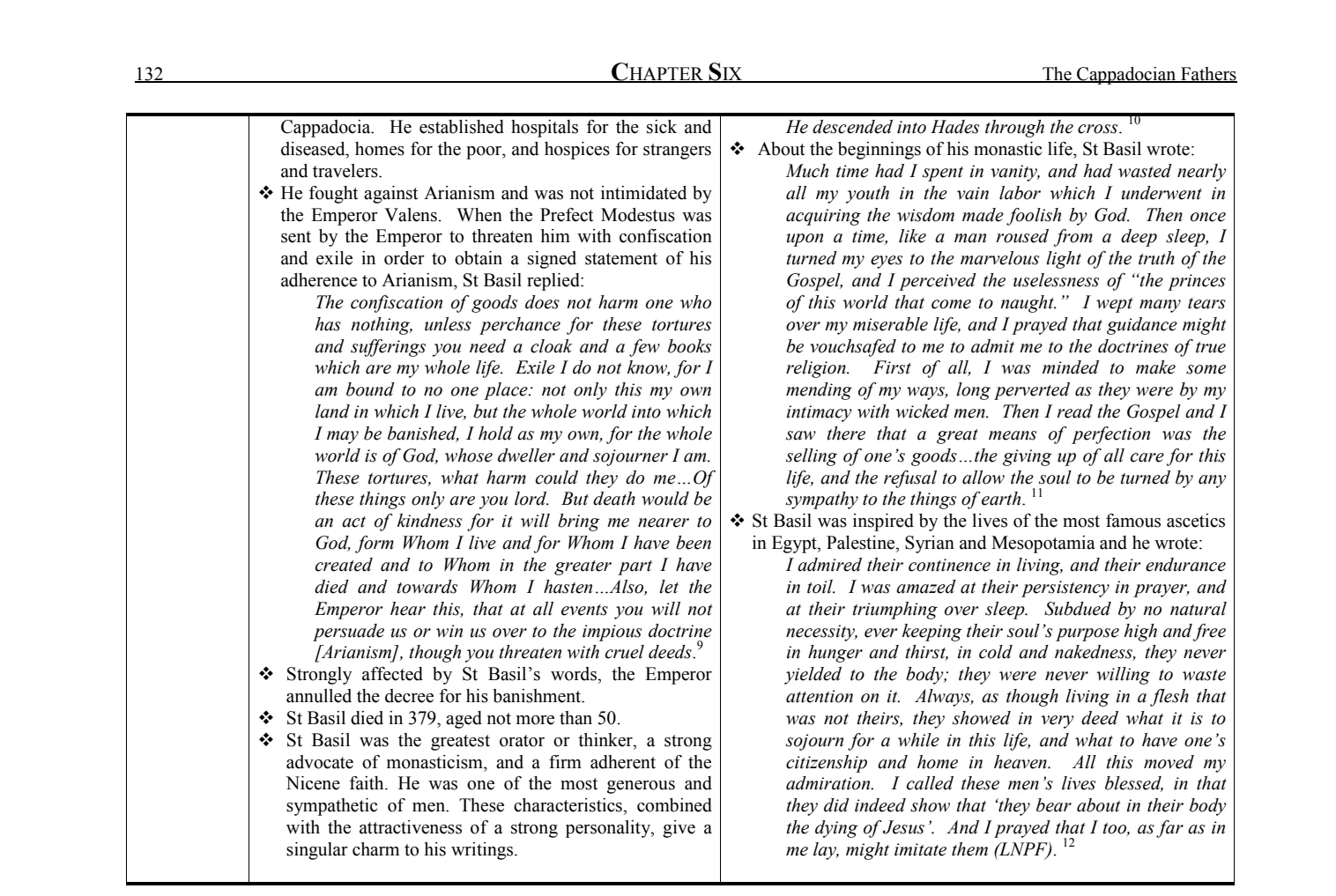
- After Eusebius died in 370, St Basil became his successor as bishop of Caesarea and metropolitan of Cappadocia. He established hospitals for the sick and diseased, homes for the poor, and hospices for strangers and travelers.
- He fought against Arianism and was not intimidated by the Emperor Valens. When the Prefect Modestus was sent by the Emperor to threaten him with confiscation and exile in order to obtain a signed statement of his adherence to Arianism, St Basil replied: The confiscation of goods does not harm one who has nothing, unless perchance for these tortures and sufferings you need a cloak and a few books which are my whole life. Exile I do not know, for I am bound to no one place: not only this my own land in which I live, but the whole world into which I may be banished, I hold as my own, for the whole world is of God, whose dweller and sojourner I am. These tortures, what harm could they do me…Of these things only are you lord. But death would be an act of kindness for it will bring me nearer to God, form Whom I live and for Whom I have been created and to Whom in the greater part I have died and towards Whom I hasten…Also, let the Emperor hear this, that at all events you will not persuade us or win us over to the impious doctrine [Arianism], though you threaten with cruel deeds.9
- Strongly affected by St Basil’s words, the Emperor annulled the decree for his banishment.
- St Basil died in 379, aged not more than 50.
- St Basil was the greatest orator or thinker, a strong advocate of monasticism, and a firm adherent of the Nicene faith. He was one of the most generous and sympathetic of men. These characteristics, combined with the attractiveness of a strong personality, give a singular charm to his writings.
WRITINGS
1. Dogmatic Works
- De Spiritu Sancto. He appeals to Scripture and early Christian tradition in support of the catholic (universal) doctrine of the Holy Spirit, and the book is at once well reasoned and edifying in tone and substance.
- Contra Eunomium, is a lengthy refutation of Anomoean Arianism.
2. Homilies
- The Hexaemeron, an Exposition of the Psalms, and addresses on a variety of subjects, doctrinal and practical.
3. Ascetic Writings
- The Moralia, rules for the ordering of life in the world, especially the life of the clergy; and two sets of Regulae, rules for the monastic state.
4. Letters
- 366 letters have survived. They possess deep feeling, great warmth of affection, and a fund of quiet humor, at times approaching to playfulness.
- It must be remembered that we are reading the self-revelations of one who struggled with constant ill-health, and whose days were full of distractions and anxieties from without.
5. The Liturgies of St Basil
- Three liturgies are attributed to St Basil: (a) that of the Byzantine Church, (b) that of the Syrian Orthodox Church, and (c) that of the Coptic Orthodox Church, of which there is also a Greek version.
- In the Anaphora of the Coptic Liturgy of St Basil, he says: He was incarnate and became man, and taught us the ways of salvation. He granted us the birth from on high through water and Spirit. He made us unto Himself a congregation, and sanctified us by Your Holy Spirit ; He loved His own who are in the world, and gave Himself up for our salvation unto death which reigned over us, whereby we were bound and sold on account of our sins, He descended into Hades through the cross. 10
- About the beginnings of his monastic life, St Basil wrote: Much time had I spent in vanity, and had wasted nearly all my youth in the vain labor which I underwent in acquiring the wisdom made foolish by God. Then once upon a time, like a man roused from a deep sleep, I turned my eyes to the marvelous light of the truth of the Gospel, and I perceived the uselessness of “the princes of this world that come to naught.” I wept many tears over my miserable life, and I prayed that guidance might be vouchsafed to me to admit me to the doctrines of true religion. First of all, I was minded to make some mending of my ways, long perverted as they were by my intimacy with wicked men. Then I read the Gospel and I saw there that a great means of perfection was the selling of one’s goods…the giving up of all care for this life, and the refusal to allow the soul to be turned by any sympathy to the things of earth. 11
- St Basil was inspired by the lives of the most famous ascetics in Egypt, Palestine, Syrian and Mesopotamia and he wrote: I admired their continence in living, and their endurance in toil. I was amazed at their persistency in prayer, and at their triumphing over sleep. Subdued by no natural necessity, ever keeping their soul’s purpose high and free in hunger and thirst, in cold and nakedness, they never yielded to the body; they were never willing to waste attention on it. Always, as though living in a flesh that was not theirs, they showed in very deed what it is to sojourn for a while in this life, and what to have one’s citizenship and home in heaven. All this moved my admiration. I called these men’s lives blessed, in that they did indeed show that ‘they bear about in their body the dying of Jesus’. And I prayed that I too, as far as in me lay, might imitate them (LNPF). 12
From A Panoramic View of Patristics by Hegumen Fr. Tadros Yacoub Malaty (Preparatory edition, February 2005, St George’s Coptic Orthodox Church, Sporting, Alexandria).
Chapter 6, Cappadocian Fathers, pp. 131–133