Church Father
From Fr. Tadros’s book
BIOGRAPHY
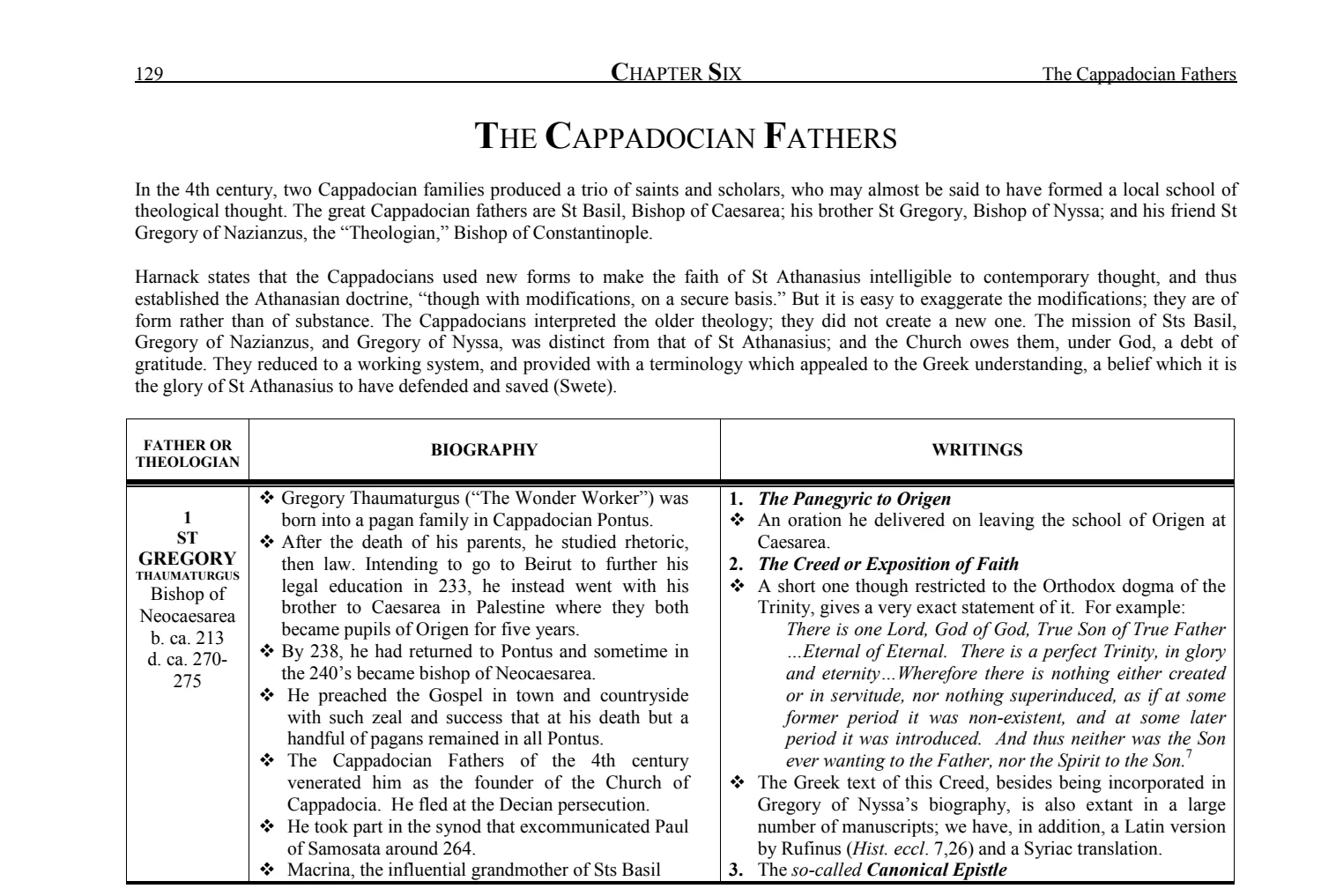
- Gregory Thaumaturgus (“The Wonder Worker”) was born into a pagan family in Cappadocian Pontus.
- After the death of his parents, he studied rhetoric, then law. Intending to go to Beirut to further his legal education in 233, he instead went with his brother to Caesarea in Palestine where they both became pupils of Origen for five years.
- By 238, he had returned to Pontus and sometime in the 240’s became bishop of Neocaesarea.
- He preached the Gospel in town and countryside with such zeal and success that at his death but a handful of pagans remained in all Pontus.
- The Cappadocian Fathers of the 4th century venerated him as the founder of the Church of Cappadocia. He fled at the Decian persecution.
- He took part in the synod that excommunicated Paul of Samosata around 264.
- Macrina, the influential grandmother of Sts Basil
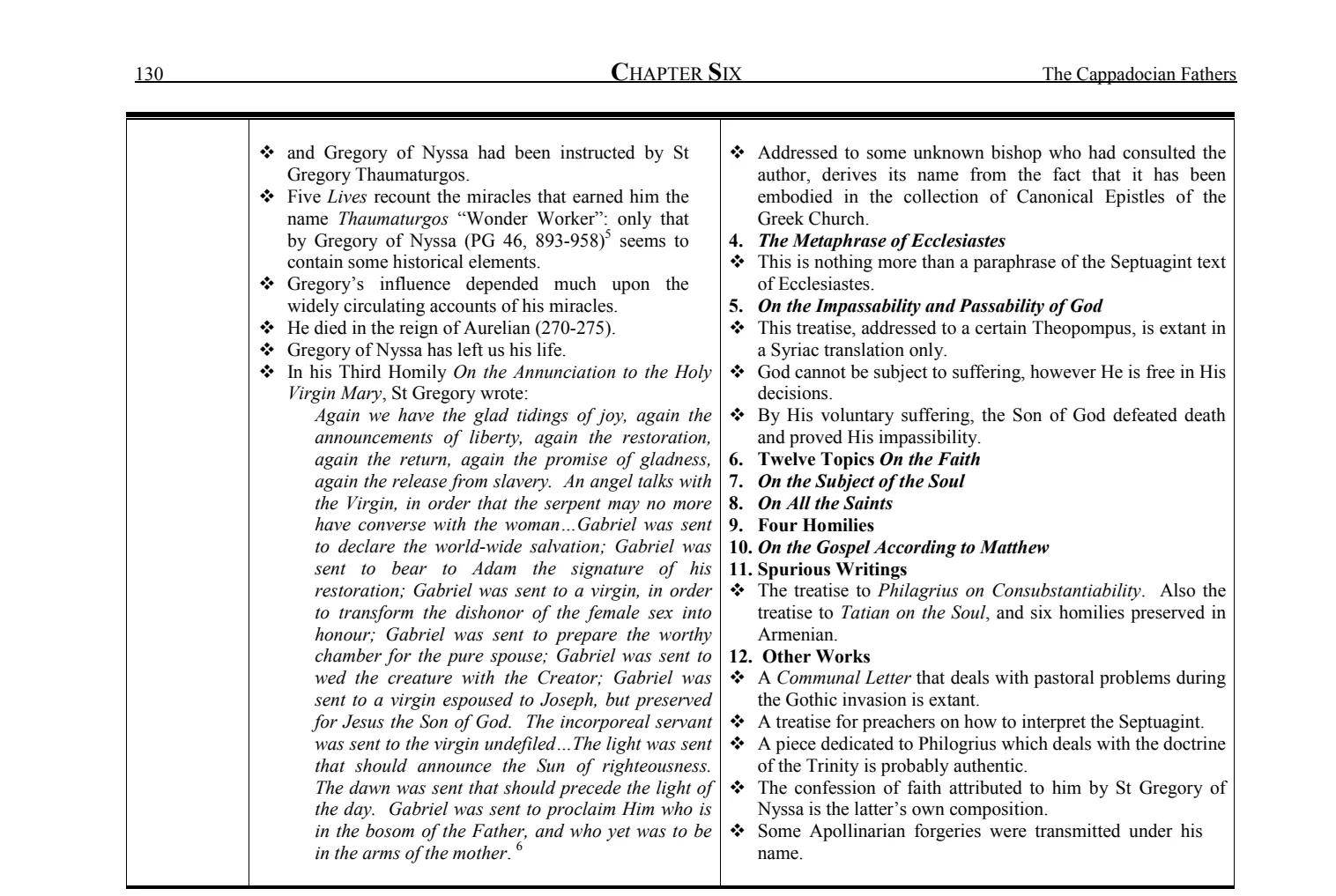
- and Gregory of Nyssa had been instructed by St Gregory Thaumaturgos.
- Five Lives recount the miracles that earned him the name Thaumaturgos “Wonder Worker”: only that by Gregory of Nyssa (PG 46, 893-958)5 seems to contain some historical elements.
- Gregory’s influence depended much upon the widely circulating accounts of his miracles.
- He died in the reign of Aurelian (270-275).
- Gregory of Nyssa has left us his life.
- In his Third Homily On the Annunciation to the Holy Virgin Mary, St Gregory wrote: Again we have the glad tidings of joy, again the announcements of liberty, again the restoration, again the return, again the promise of gladness, again the release from slavery. An angel talks with the Virgin, in order that the serpent may no more have converse with the woman…Gabriel was sent to declare the world-wide salvation; Gabriel was sent to bear to Adam the signature of his restoration; Gabriel was sent to a virgin, in order to transform the dishonor of the female sex into honour; Gabriel was sent to prepare the worthy chamber for the pure spouse; Gabriel was sent to wed the creature with the Creator; Gabriel was sent to a virgin espoused to Joseph, but preserved for Jesus the Son of God. The incorporeal servant was sent to the virgin undefiled…The light was sent that should announce the Sun of righteousness. The dawn was sent that should precede the light of the day. Gabriel was sent to proclaim Him who is in the bosom of the Father, and who yet was to be in the arms of the mother. 6
WRITINGS
1. The Panegyric to Origen
- An oration he delivered on leaving the school of Origen at Caesarea.
2. The Creed or Exposition of Faith
- A short one though restricted to the Orthodox dogma of the Trinity, gives a very exact statement of it. For example: There is one Lord, God of God, True Son of True Father …Eternal of Eternal. There is a perfect Trinity, in glory and eternity…Wherefore there is nothing either created or in servitude, nor nothing superinduced, as if at some former period it was non-existent, and at some later period it was introduced. And thus neither was the Son ever wanting to the Father, nor the Spirit to the Son.7
- The Greek text of this Creed, besides being incorporated in Gregory of Nyssa’s biography, is also extant in a large number of manuscripts; we have, in addition, a Latin version by Rufinus (Hist. eccl. 7,26) and a Syriac translation.
3. The so-called Canonical Epistle
- Addressed to some unknown bishop who had consulted the author, derives its name from the fact that it has been embodied in the collection of Canonical Epistles of the Greek Church.
4. The Metaphrase of Ecclesiastes
- This is nothing more than a paraphrase of the Septuagint text of Ecclesiastes.
5. On the Impassability and Passability of God
- This treatise, addressed to a certain Theopompus, is extant in a Syriac translation only.
- God cannot be subject to suffering, however He is free in His decisions.
- By His voluntary suffering, the Son of God defeated death and proved His impassibility.
6. Twelve Topics On the Faith 7. On the Subject of the Soul 8. On All the Saints 9. Four Homilies 10. On the Gospel According to Matthew 11. Spurious Writings
- The treatise to Philagrius on Consubstantiability. Also the treatise to Tatian on the Soul, and six homilies preserved in Armenian.
12. Other Works
- A Communal Letter that deals with pastoral problems during the Gothic invasion is extant.
- A treatise for preachers on how to interpret the Septuagint.
- A piece dedicated to Philogrius which deals with the doctrine of the Trinity is probably authentic.
- The confession of faith attributed to him by St Gregory of Nyssa is the latter’s own composition.
- Some Apollinarian forgeries were transmitted under his name.
From A Panoramic View of Patristics by Hegumen Fr. Tadros Yacoub Malaty (Preparatory edition, February 2005, St George’s Coptic Orthodox Church, Sporting, Alexandria).
Chapter 6, Cappadocian Fathers, pp. 129–131