Church Father
From Fr. Tadros’s book
ABOUT HIS WRITINGS
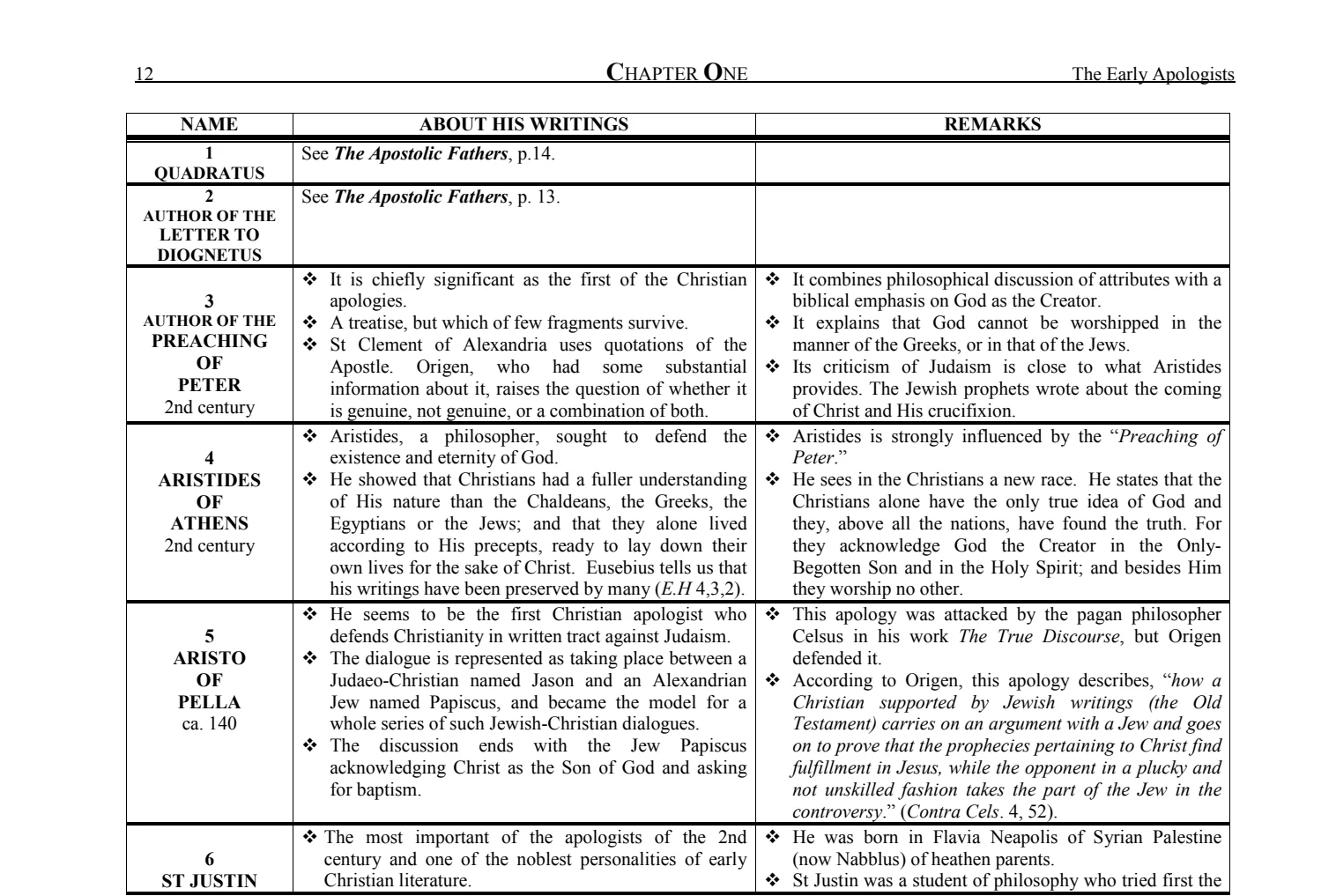
- The most important of the apologists of the 2nd century and one of the noblest personalities of early Christian literature.
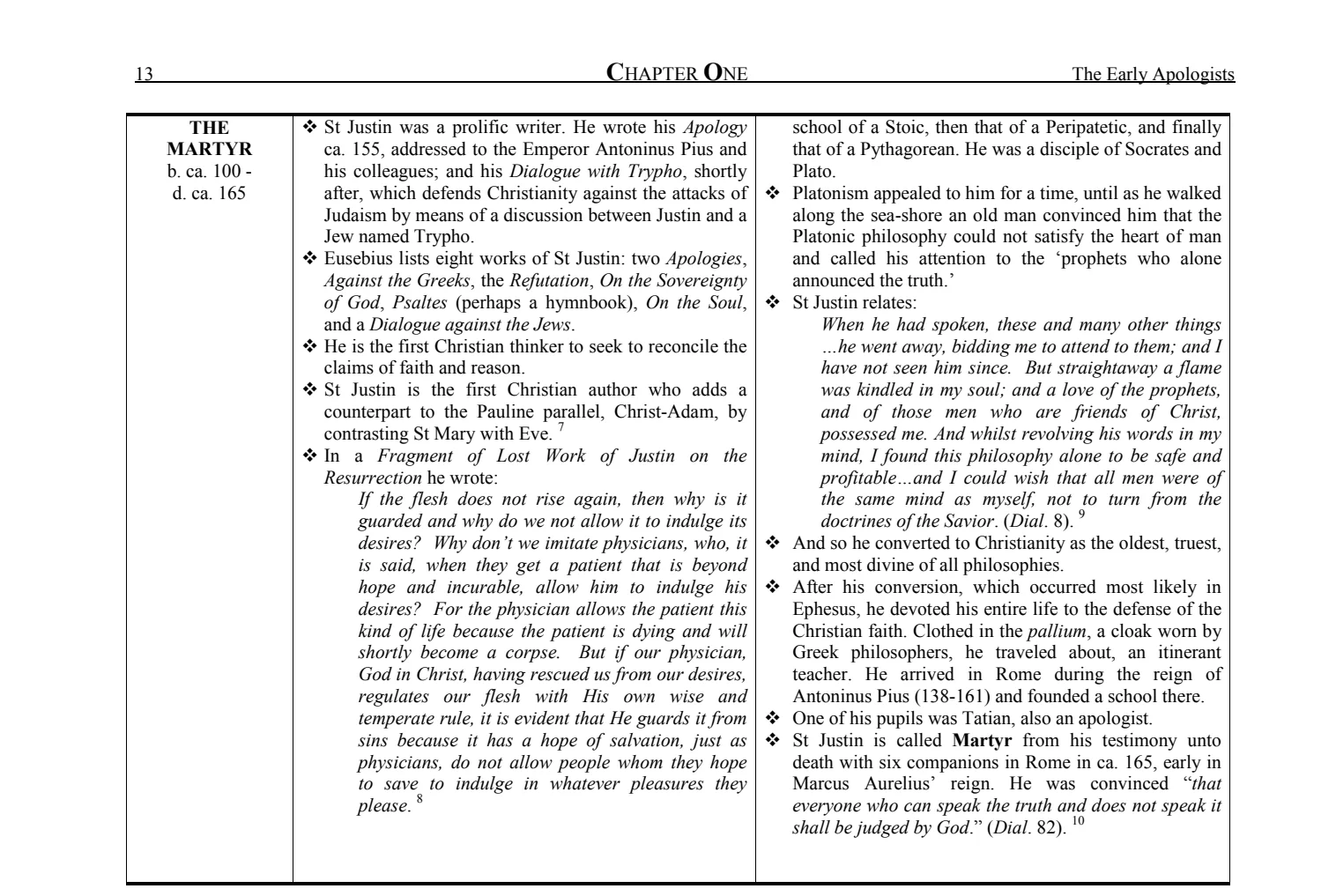
- St Justin was a prolific writer. He wrote his Apology ca. 155, addressed to the Emperor Antoninus Pius and his colleagues; and his Dialogue with Trypho, shortly after, which defends Christianity against the attacks of Judaism by means of a discussion between Justin and a Jew named Trypho.
- Eusebius lists eight works of St Justin: two Apologies, Against the Greeks, the Refutation, On the Sovereignty of God, Psaltes (perhaps a hymnbook), On the Soul, and a Dialogue against the Jews.
- He is the first Christian thinker to seek to reconcile the claims of faith and reason.
- St Justin is the first Christian author who adds a counterpart to the Pauline parallel, Christ-Adam, by contrasting St Mary with Eve. 7
- In a Fragment of Lost Work of Justin on the Resurrection he wrote: If the flesh does not rise again, then why is it guarded and why do we not allow it to indulge its desires? Why don’t we imitate physicians, who, it is said, when they get a patient that is beyond hope and incurable, allow him to indulge his desires? For the physician allows the patient this kind of life because the patient is dying and will shortly become a corpse. But if our physician, God in Christ, having rescued us from our desires, regulates our flesh with His own wise and temperate rule, it is evident that He guards it from sins because it has a hope of salvation, just as physicians, do not allow people whom they hope to save to indulge in whatever pleasures they please. 8
REMARKS
- He was born in Flavia Neapolis of Syrian Palestine (now Nabblus) of heathen parents.
- St Justin was a student of philosophy who tried first the school of a Stoic, then that of a Peripatetic, and finally that of a Pythagorean. He was a disciple of Socrates and Plato.
- Platonism appealed to him for a time, until as he walked along the sea-shore an old man convinced him that the Platonic philosophy could not satisfy the heart of man and called his attention to the ‘prophets who alone announced the truth.’
- St Justin relates: When he had spoken, these and many other things …he went away, bidding me to attend to them; and I have not seen him since. But straightaway a flame was kindled in my soul; and a love of the prophets, and of those men who are friends of Christ, possessed me. And whilst revolving his words in my mind, I found this philosophy alone to be safe and profitable…and I could wish that all men were of the same mind as myself, not to turn from the doctrines of the Savior. (Dial. 8). 9
- And so he converted to Christianity as the oldest, truest, and most divine of all philosophies.
- After his conversion, which occurred most likely in Ephesus, he devoted his entire life to the defense of the Christian faith. Clothed in the pallium, a cloak worn by Greek philosophers, he traveled about, an itinerant teacher. He arrived in Rome during the reign of Antoninus Pius (138-161) and founded a school there.
- One of his pupils was Tatian, also an apologist.
- St Justin is called Martyr from his testimony unto death with six companions in Rome in ca. 165, early in Marcus Aurelius’ reign. He was convinced “that everyone who can speak the truth and does not speak it shall be judged by God.” (Dial. 82). 10
From A Panoramic View of Patristics by Hegumen Fr. Tadros Yacoub Malaty (Preparatory edition, February 2005, St George’s Coptic Orthodox Church, Sporting, Alexandria).
Chapter 1, Early apologists, pp. 12–14